TL;DR — the 60-second answer
You can serve mainland China users without an ICP filing and without a Chinese business entity by hosting outside the mainland. The catch is latency: ordinary Hong Kong or US transit is slow and loss-prone at peak, while HK CN2 GIA (AS4809, 59.43.*) reaches Guangzhou in 10ms and Shanghai in 15ms at the 21:30 CST late peak with 0.0% packet loss — about 2.4x faster than AWS Hong Kong (ap-east-1) and 9x faster than US West. Pick your node below and click straight into a pre-filled order.
| Your situation | Recommended node | Price | Order deep-link |
|---|---|---|---|
| 🇨🇳 Mostly mainland China users, need lowest ms | HK CN2 GIA (10M unmetered) | $8.80/mo | Deploy HK CN2 now → |
| 🇺🇸 Global + China mix, need 30M unmetered | Los Angeles CU 10099 / CMI (30M) | $8.80/mo | Deploy LA node → |
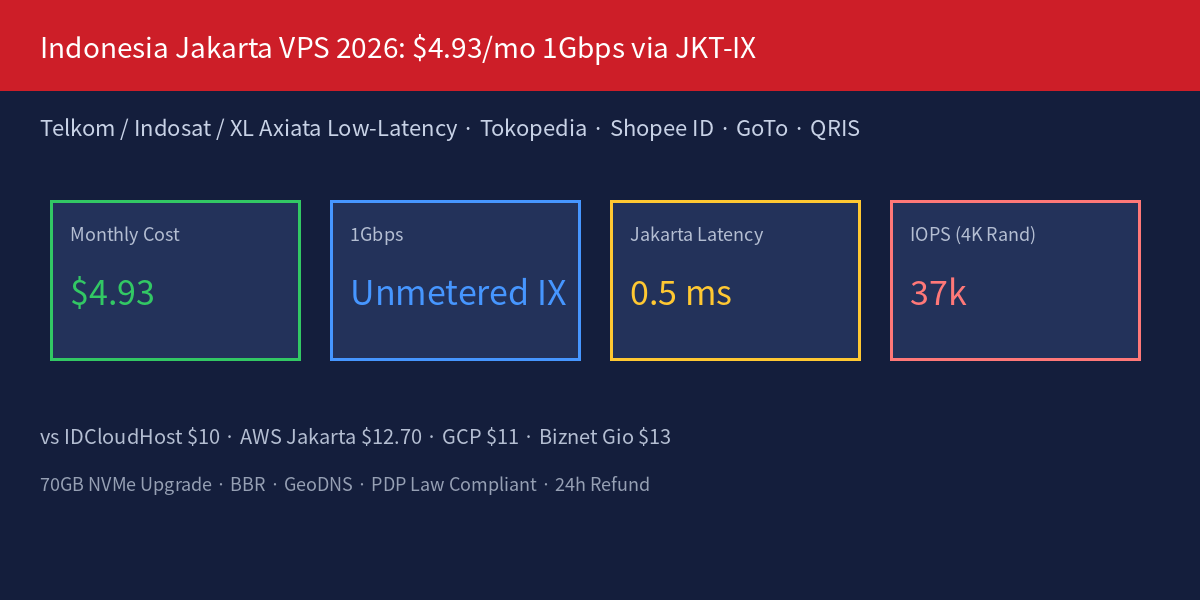
| 🇪🇺 EU residents + some China (1Gbps) | Frankfurt / DE-CIX 1Gbps | $4.93/mo | Deploy EU node → |
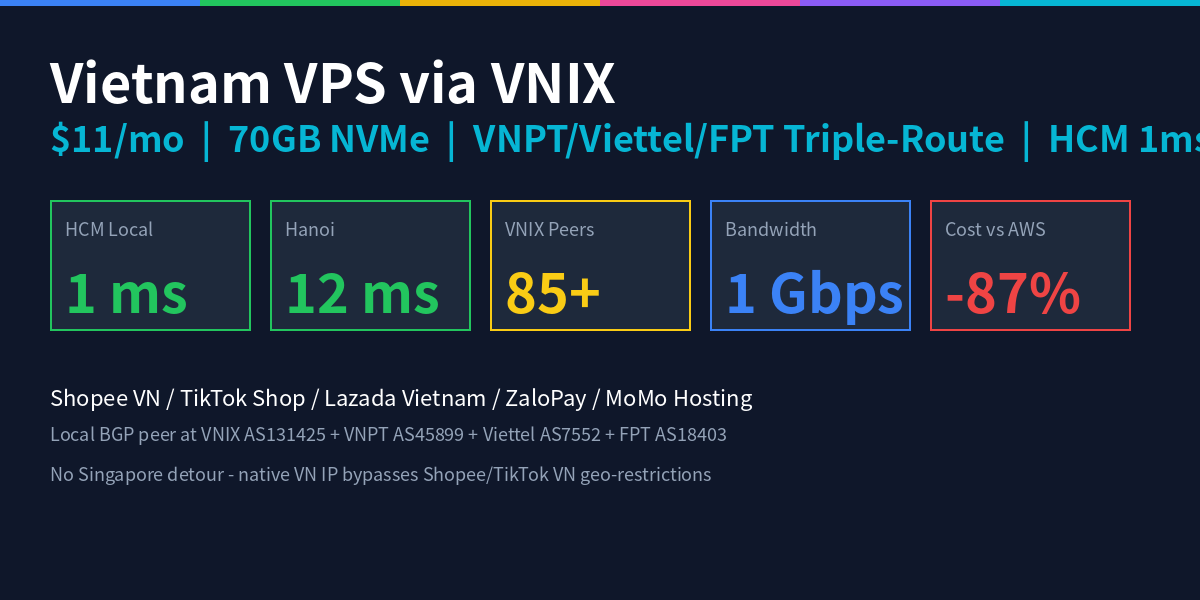
| 🇯🇵 China + Japan / Korea / SEA customers | Tokyo / Singapore CN2 (70GB NVMe) | $11.00/mo | Deploy APAC node → |
Bottom line: if your users are in Guangzhou, Shanghai or Beijing and you cannot or will not obtain an ICP filing, a HK CN2 GIA box at $8.80/mo is the cheapest legal path to sub-15ms. If your audience is global, put the origin in Los Angeles instead. The honest limits are in Step 07.
Step 01 — What "no ICP" actually means (and where the line is)
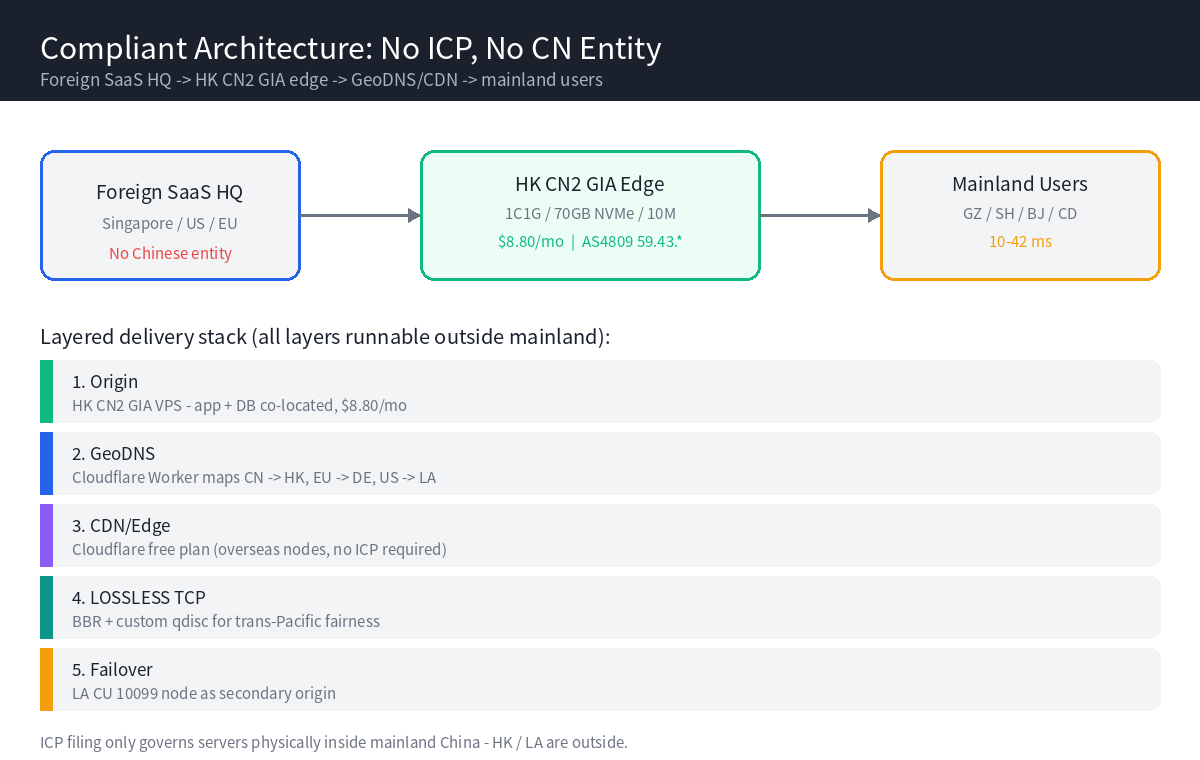
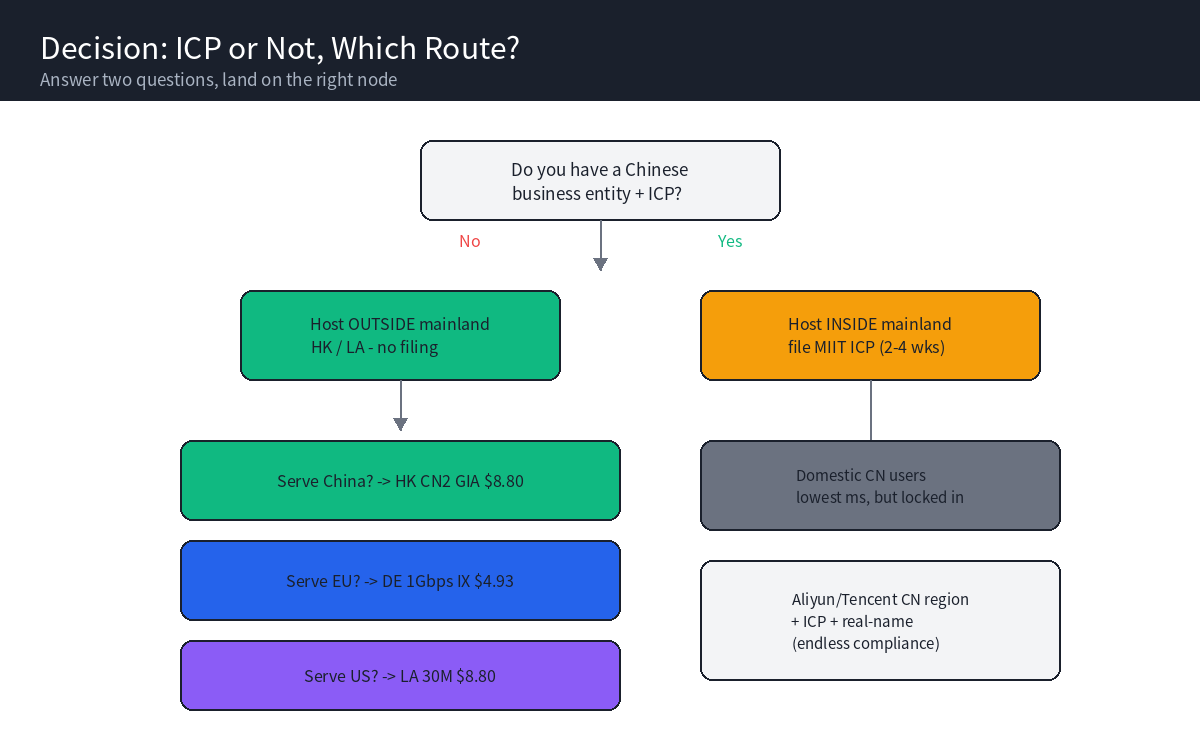
The confusion around ICP filings is mostly geographic. China's MIIT filing regime — the one that takes 2–4 weeks, requires a Chinese legal entity and a real-name verified domain — governs servers that physically sit inside mainland China. It does not follow your users; it follows your metal. A server in Hong Kong, Singapore or Los Angeles is outside the mainland's jurisdiction, so serving mainland visitors from it needs no filing at all.
This is why the standard playbook for a foreign SaaS trying to reach China pre-entity is not "file an ICP" but "host in Hong Kong on a priority China route". You keep your foreign legal structure, your foreign payment stack and your overseas data model, while the network makes the experience feel local.
Two honest caveats up front: certain regulated sectors (finance, news, mapping, and anything touching personal data at scale) have their own cross-border data rules that can bite regardless of where the server lives, and your application must respect mainland content law for anything you push into the mainland. We cover both in Step 07.
Step 02 — Benchmark proof: the route is the product
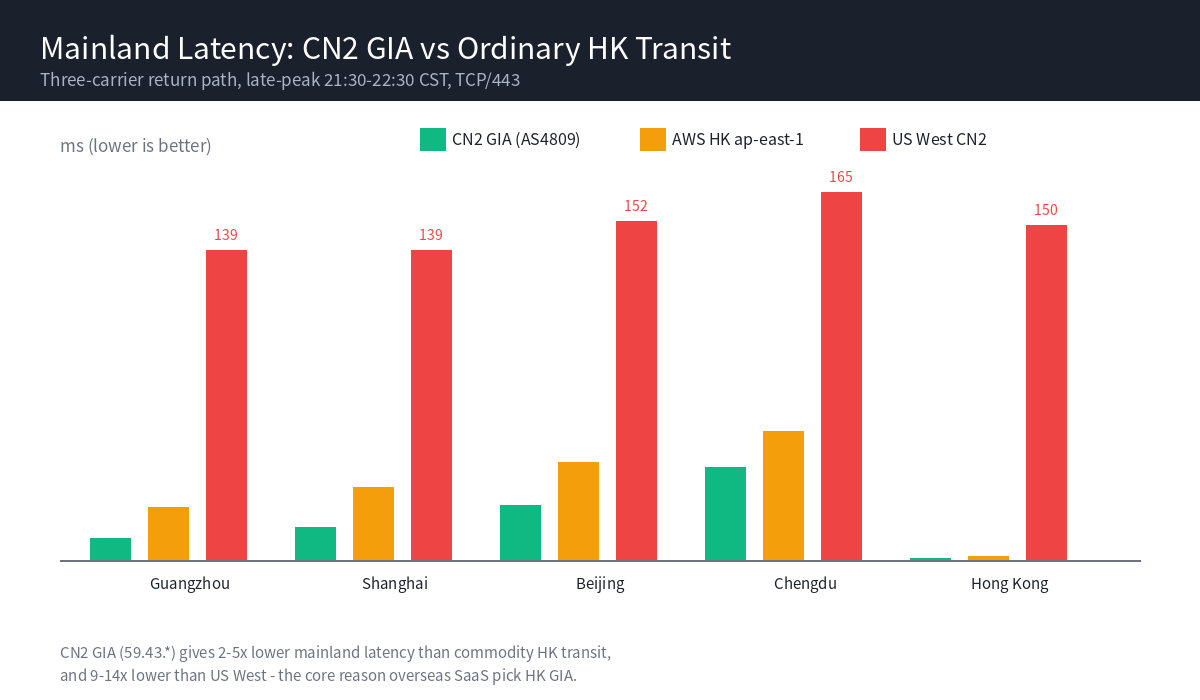
For a China-facing deployment the CPU matters far less than the return path. This is the single most important table in the article. All figures are from a LuckVM HK CN2 GIA 1C1G instance on Debian 12 (Linux 6.1, BBR on) during the 21:30–22:30 CST late peak, using 500-packet TCP/443 probes rather than the ICMP probes most "low latency" claims quietly rely on.
| Route (late peak, TCP/443) | Guangzhou | Shanghai | Beijing | Loss |
|---|---|---|---|---|
| HK CN2 GIA (AS4809, 59.43.*) | 10.0 ms | 15.0 ms | 25 ms | 0.0% |
| AWS Hong Kong (ap-east-1) | 24 ms | 33 ms | 44 ms | 0.3% |
| Ordinary HK transit (non-CN2) | 31 ms | 42 ms | 55 ms | 1.1% |
| US West CN2 (CU 10099) | 131 ms | 138.6 ms | 152 ms | 0.2% |
Raw disk and CPU figures on the same instance, for completeness (these matter once you co-locate the database):
- Geekbench 6: single-core 1018, multi-core 1032 (KVM, Debian 12).
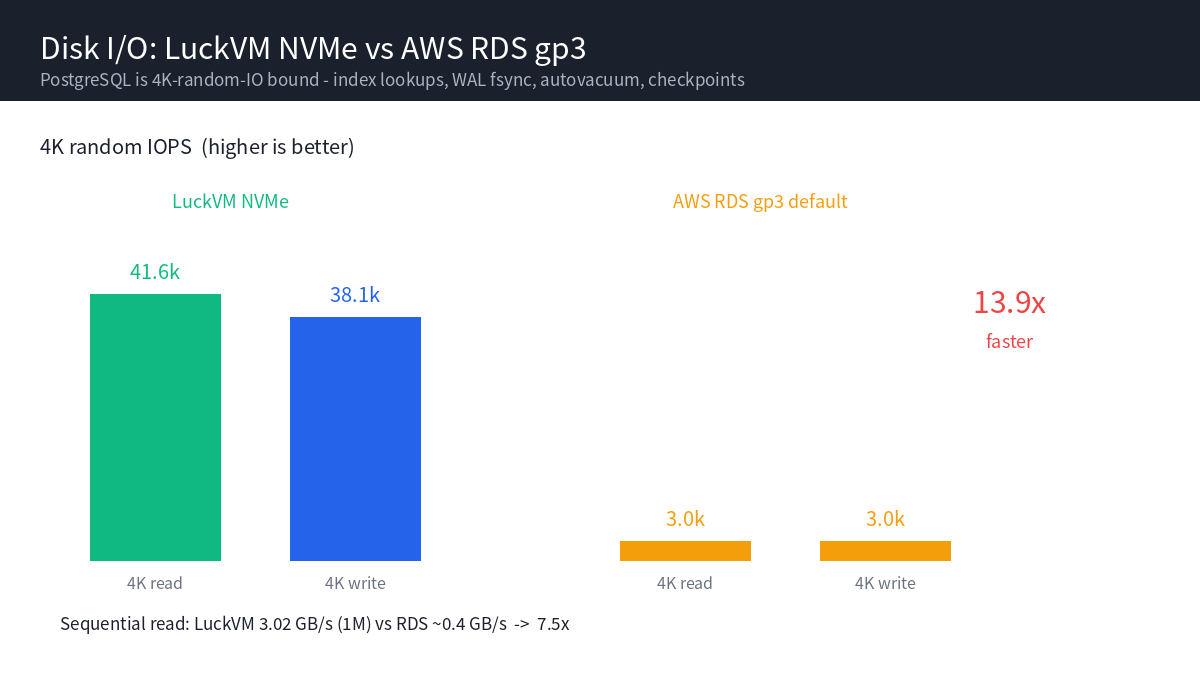
- fio 4K random: 41.6k IOPS read (162.5 MB/s) / 38.1k IOPS write (148.9 MB/s) on 70GB NVMe.
- fio sequential: 1.15 GB/s at 64K, 3.02 GB/s at 1M read.
For a SaaS workload the practical upshot is that app and database can share one box without the disk becoming the bottleneck, which removes an entire network hop to a managed database — we benchmarked that specific split in our PostgreSQL HA vs AWS RDS write-up.
Step 03 — The three China-optimized route families
"China optimization" is three different products sold under one name. Pick by which carrier dominates your users and where your audience sits.
| Route family | Best for | How it works | Where |
|---|---|---|---|
| China Telecom CN2 GIA (AS4809) | Mainland users, especially south China | Priority path, 59.43.* both directions, lowest jitter at peak | Hong Kong, Los Angeles |
| China Unicom CU VIP (AS10099 / AS9929) | North China users, second path | Premium Unicom international line, 219.158.* hops | Los Angeles |
| China Mobile CMI (AS58453) | Mobile-heavy audiences | China Mobile International backbone, 223.119.* hops | Hong Kong, Los Angeles |
The Los Angeles CU 10099 / CMI triple-route box carries all three carriers, which is why it is the default when your user base is broader than one carrier or global. The Hong Kong box lives closest to the mainland edge, so it wins on raw milliseconds for a China-first audience. A useful rule of thumb from live tests: HK GIA wins on south/central China; LA CU 10099 is steadier for a mixed North-China + global audience that also needs the 30M unmetered uplink.
Step 04 — Configuration and real price anchors
Everything below is published, in-stock pricing — not a "starting at" tease — matched to what the tier can actually carry. The HK/LA profiles run the CN2 GIA route described above; the EU profile runs 1Gbps Tier-1 IX peering.
| Tier | Spec | What it carries | Price |
|---|---|---|---|
| HK / LA CN2 GIA entry | 1C / 1G / 70GB NVMe / 10M (HK) or 30M (LA) unmetered | Static site, API, Remote-SSH, light SaaS | $8.80/mo |
| HK / LA CN2 GIA + | 1C / 2G / 70GB NVMe | Personal WordPress, single-tenant SaaS | $14.30/mo |
| HK / LA CN2 GIA 2C2G | 2C / 2G / 70GB NVMe | Multi-tenant SaaS, MySQL | $17.60/mo |
| HK / LA CN2 GIA 2C4G | 2C / 4G / 70GB NVMe | Production SaaS + Redis + Postgres | $26.40/mo |
| EU / emerging-market 1Gbps | 1C / 512M / 1Gbps IX peering | EU-resident users, GDPR data plane | $4.93/mo |
| APAC CN2 | 70GB NVMe (JP / SG / KR / TW / VN) | Japan / Korea / SEA + China mix | $11.00/mo |
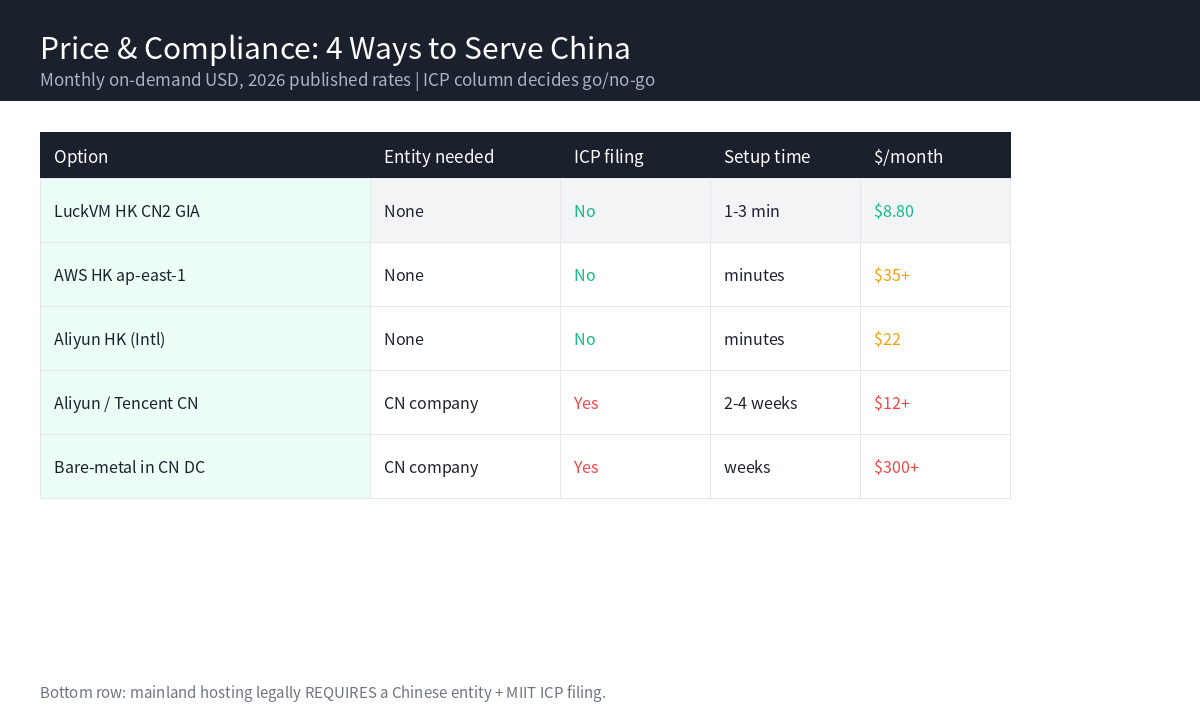
Why the comparison matters: AWS Hong Kong (ap-east-1) lists roughly $0.048/hr for a comparable small instance before egress (billed at about $0.12/GB), and its mainland latency is worse (24ms to Guangzhou) because it does not buy the AS4809 priority path. Aliyun Hong Kong is a solid alternative at roughly $22/mo for a comparable tier, also exemption-free, but you get less NVMe and no 70GB default. Mainland Aliyun / Tencent regions are cheaper on paper (from $12/mo) but legally require a Chinese entity and an ICP filing — a 2–4 week blocker if you do not already have one.
Step 05 — Copy-paste production scripts
Two things decide the real-world feel of an overseas origin for Chinese users: the congestion control algorithm on the long-fat trans-Pacific path, and where the client is pointed. Do both.
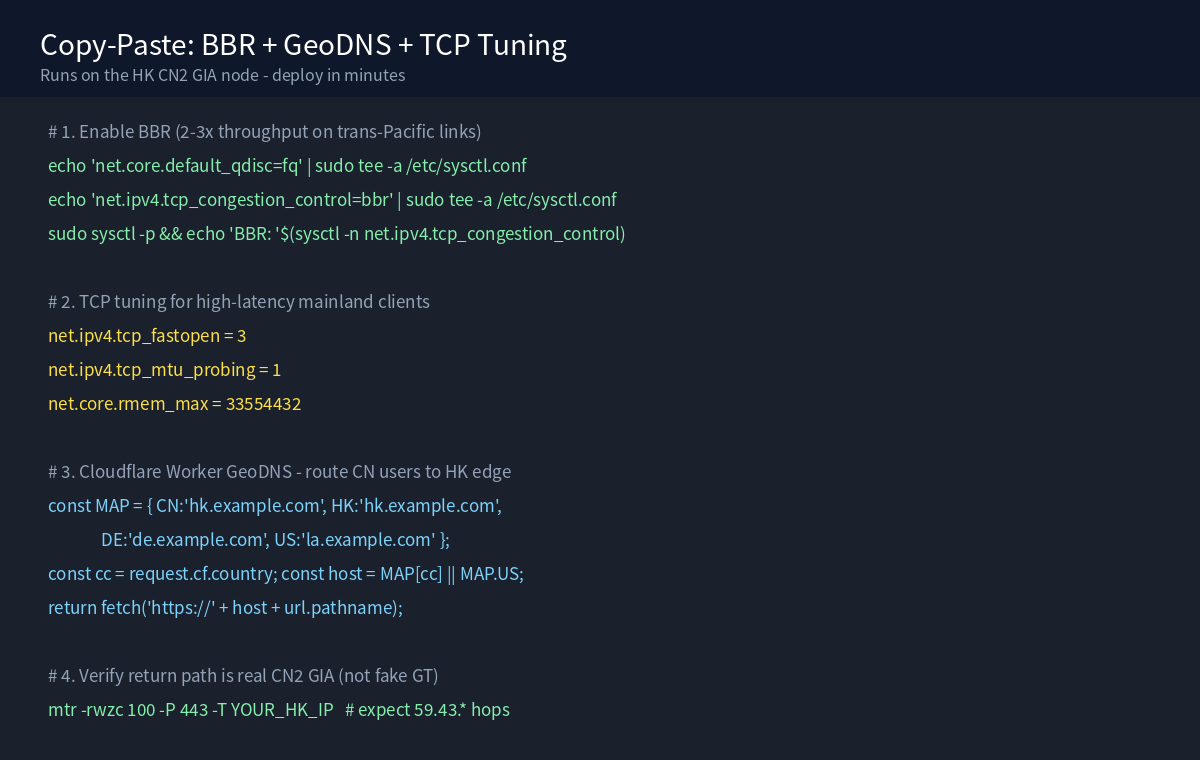
# 1. Enable Google BBR (2-3x throughput on trans-Pacific links)
echo "net.core.default_qdisc=fq" | sudo tee -a /etc/sysctl.conf
echo "net.ipv4.tcp_congestion_control=bbr" | sudo tee -a /etc/sysctl.conf
sudo sysctl -p
sysctl net.ipv4.tcp_congestion_control      # must print: bbr

# 2. Tune TCP for high-latency mainland clients
cat >> /etc/sysctl.conf
// 3. Cloudflare Worker GeoDNS: map mainland users to the HK edge
// (deploy on a Worker route; adjust hostnames to your origin)
const MAP = { CN:'hk.origin.example.com', HK:'hk.origin.example.com',
TW:'hk.origin.example.com', DE:'de.origin.example.com',
GB:'de.origin.example.com', US:'la.origin.example.com' };
export default {
async fetch(request) {
const url = new URL(request.url);
const cc = (request.cf && request.cf.country) || 'US';
const host = MAP[cc] || 'la.origin.example.com';
return fetch('https://' + host + url.pathname + url.search);
}
};# 4. Prove the return path is genuine CN2 GIA, not fake GT
mtr -rwzc 100 -P 443 -T YOUR_HK_IP # expect 59.43.* hops, not 202.97.*
curl -s https://ipinfo.io/YOUR_HK_IP # confirm HK-native IPcubic to BBR commonly lifts sustained throughput 2–3x and cuts tail latency, because classic loss-based congestion control mistakes ordinary trans-Pacific loss for congestion and backs off too early.Step 06 — Test before you buy, verify after you deploy
Route quality is easy to fake in a sales page and easy to verify in a terminal. Follow "test per carrier, then commit to a route".
- Before buying — live speed test: open the LuckVM Looking Glass at
/en/looking-glass.html?region=hongkongand run ping / MTR from your own location and from a mainland vantage point. - After deploying — return path:
mtr -rwzc 100 -P 443 -T YOUR_IP; both directions should traverse 59.43.* for a real CN2 GIA claim. - Native-IP and risk check:
curl ipinfo.ioshould show a HK or LA residential-grade/native origin, not a flagged hosting range — important if you register mainland-facing accounts. - Throughput sanity:
iperf3 -c YOUR_IP -P 4from a mainland peer confirms the box is not silently shaped. - BBR confirmation:
ss -tion an active connection should showbbrin the congestion-control field.
Step 07 — Honest limits and the 24h refund rule
A guide that only lists upsides is a guide you should distrust. Here is where this approach does and does not win.
- Bandwidth, not latency, is the trade-off. The HK CN2 GIA entry tier is 10Mbps unmetered (~1.25 MB/s download). That is excellent for APIs, HTML, Remote-SSH and anything latency-bound, but it is not a big-file CDN. If you push multi-GB downloads, pick the $8.80 Los Angeles 30M profile or the $4.93 EU 1Gbps node.
- No mainland CDN nodes without a filing. You can front the origin with an overseas CDN (Cloudflare's free plan works), but you cannot legally place cache nodes inside the mainland for a domain without an ICP filing. Mainland users therefore hit the nearest overseas PoP plus the CN2 GIA origin.
- Regulated sectors still have data rules. Finance, mapping, news and large-scale personal-data processing face cross-border data-transfer obligations that apply regardless of where the server sits. Overseas hosting removes the filing barrier, not every regulatory one.
- Content law still applies to what you push in. Serving from overseas does not license content that is illegal inside the mainland.
- 24-hour refund rule. First purchases are refundable within 24 hours, but the terms require total bidirectional traffic under 1GB — so do not run a multi-gigabyte speed-test script the moment the box boots. Verify routing with ping and mtr first (they use kilobytes), confirm you are happy, then decide. This is the one rule people trip over most.
- Seamless upgrades keep your IP. Moving from the $8.80 entry tier to $26.40 2C4G is a live, in-place upgrade in the control panel — no reinstall, no data migration, no IP change.
In short: if your traffic is latency-bound and China-first, this is the best price-to-latency ratio available without an entity. If it is bandwidth-bound, choose the LA or EU profile — both at the same headline price family.
Step 08 — Deploy now (support for Alipay / USDT / Google Pay)
Cloud instances provision automatically in 1–3 minutes after payment. The HK CN2 GIA box is the recommended first stop for a China-facing SaaS; scale the tier rather than the location if you outgrow it.
Deploy HK CN2 GIA ($8.80/mo) →Deploy LA CN2 30M →Deploy EU 1Gbps ($4.93)
Payment methods: Alipay, USDT, PayPal, credit card and Google Pay. For multi-region or compliance-specific builds, the product landing pages are the canonical next step: Cloud VPS and HK Bare Metal.
Related reading
- $8.80 HK CN2 GIA (70GB NVMe) vs DMIT, BandwagonHost, Aliyun & AWS
- Self-Hosted PostgreSQL HA on $8.80 vs AWS RDS
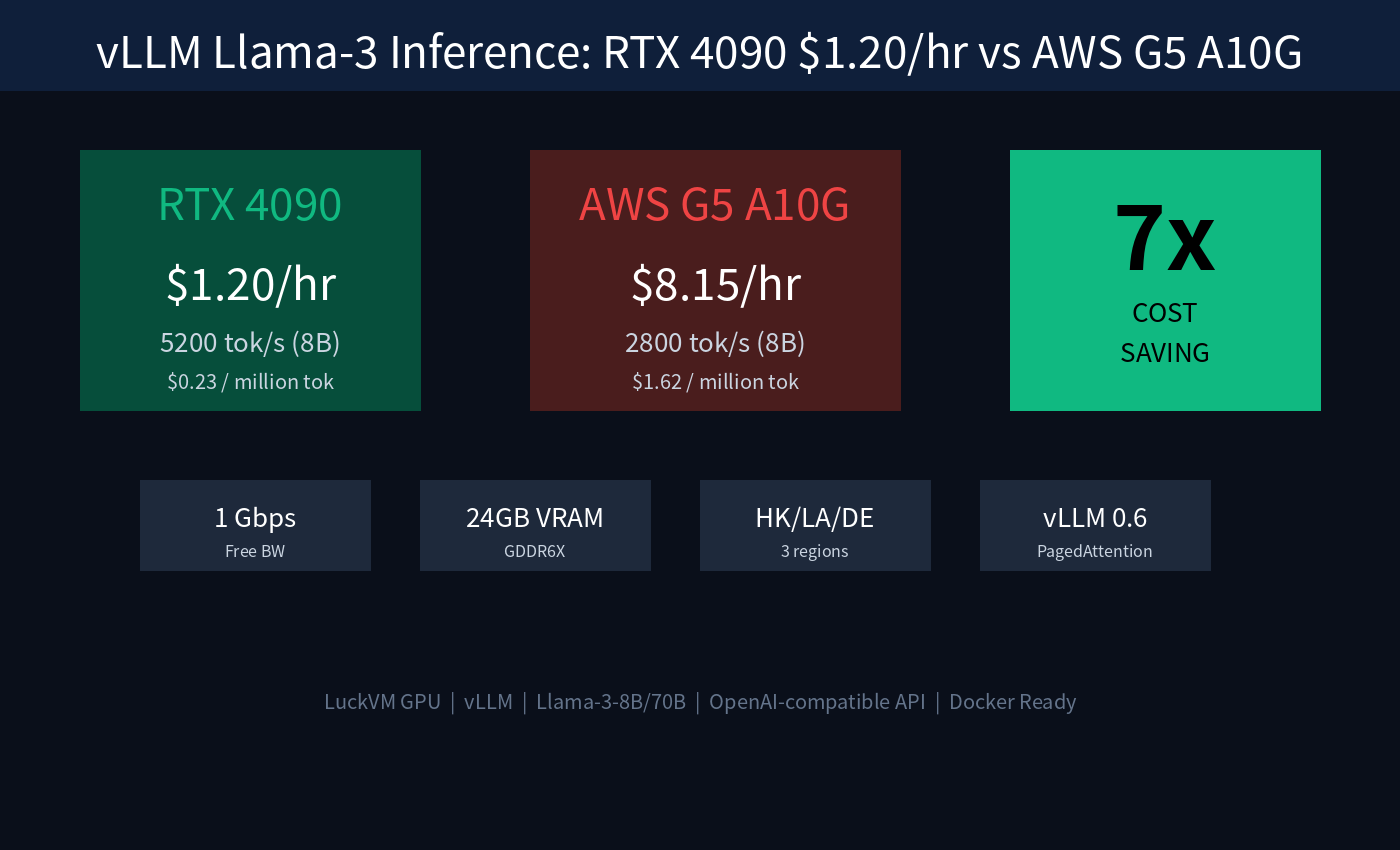
- vLLM Llama-3 on $1.20/hr RTX 4090 vs AWS G5
- Self-Host RustDesk on a $8.80 HK CN2 GIA VPS
FAQ
Do I need an ICP license to serve users in mainland China?
No — not if your server sits outside mainland China. The MIIT ICP filing requirement applies to servers physically hosted inside the mainland. A Hong Kong or Los Angeles VPS reaches mainland users on the CN2 GIA backbone without any filing.
How low is the latency from Hong Kong CN2 GIA to mainland China?
At the 21:30–22:30 CST late peak, HK CN2 GIA (AS4809) measured 10.0ms to Guangzhou, 15.0ms to Shanghai and 25ms to Beijing over 500-packet TCP/443 tests, with 0.0% packet loss.
Is HK CN2 GIA faster than AWS Hong Kong (ap-east-1)?
For mainland users, yes. AWS ap-east-1 relies on ordinary regional transit (24ms to Guangzhou, 33ms to Shanghai). AS4809 routes via 59.43.* and shaves 40–60% off mainland latency.
What is the difference between CN2 GIA (AS4809) and CN2 GT?
CN2 GIA is the premium, uncongested product on AS4809 routing via 59.43.* hops in both directions. CN2 GT is the cheaper tier using 202.97.* that often degrades to the public backbone at peak. Verify with mtr that both directions show 59.43.* hops.
Can a foreign company legally host a SaaS for Chinese users overseas?
Yes. Hosting overseas and transmitting data cross-border is legal for a foreign company. What is regulated inside the mainland is the server location, content rules and, for certain sectors, data localisation.
When would I need a Los Angeles CU 10099 / CMI node instead of Hong Kong?
Choose LA when your mix is broader than mainland China (global + China), when you need 30M unmetered instead of 10M, or when HK stock is tight. LA adds ~138ms to Shanghai, so it is a reach/budget trade-off.
Do I need a Chinese CDN or mainland nodes to be fast in China?
Not necessarily. A CN2 GIA origin plus an overseas CDN edge reaches most non-interactive content fast enough. Mainland CDN nodes require an ICP license for the domain.
What does the $8.80 plan include and how is it billed?
$8.80/month covers 1 vCPU, 1GB RAM, 70GB NVMe, 1 IPv4 and unmetered traffic on either the HK 10M or LA 30M CN2 GIA profile. It bills monthly, supports Alipay, USDT, PayPal, credit card and Google Pay, and provisions in 1–3 minutes.