1. Why this question still matters in 2026
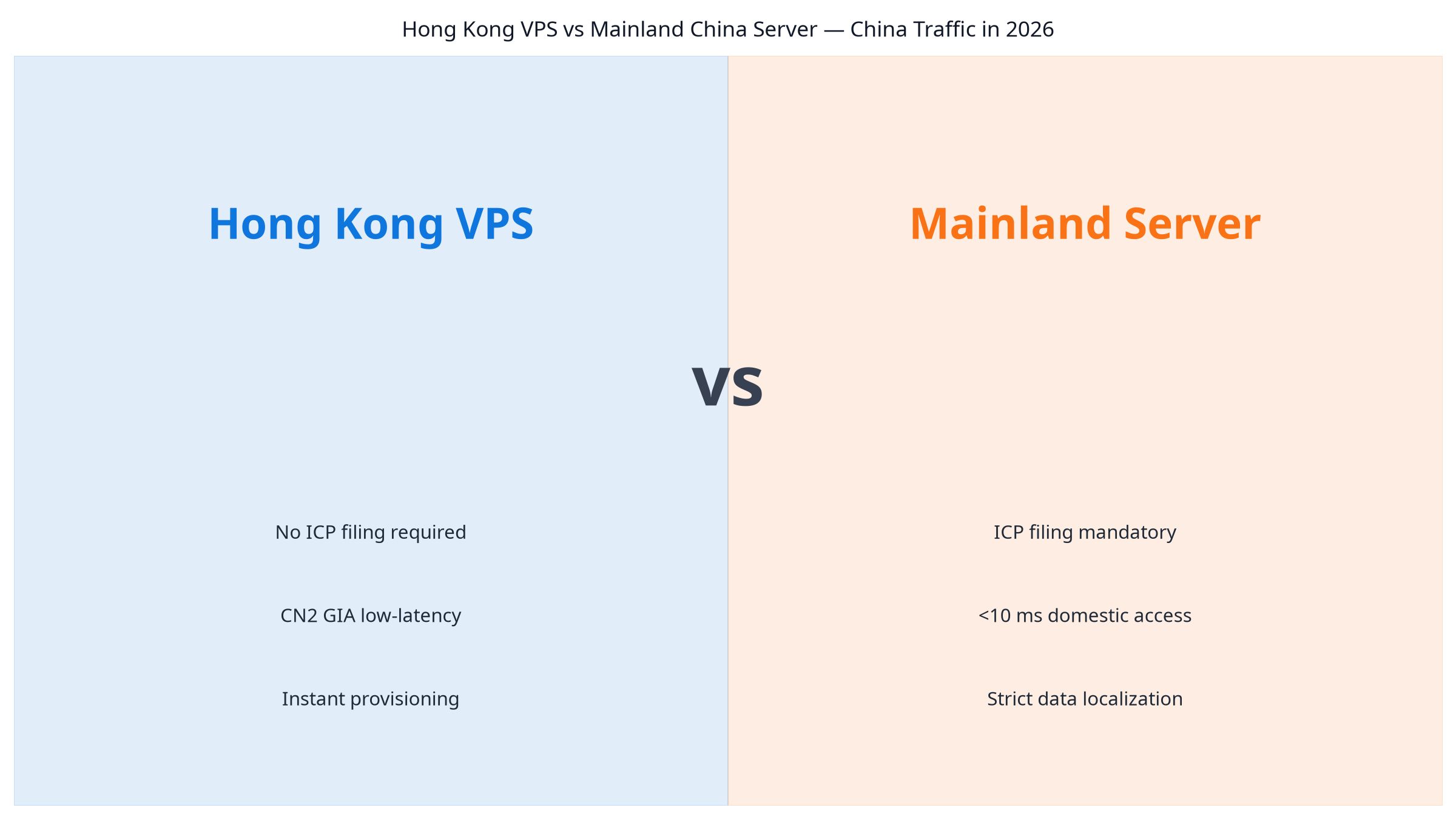
Anyone selling to or serving users in mainland China eventually faces the same fork in the road: host inside mainland China for lowest latency, or host in Hong Kong to avoid the ICP filing maze. As of 2026, neither side has rendered the other obsolete:
- Mainland China servers remain the fastest way to serve Chinese domestic users — sub-10 ms RTT in major cities, native BGP across China Telecom / China Unicom / China Mobile, and the only option if you want to operate on Chinese soil legally without workarounds.
- Hong Kong VPS instances, especially those on China Telecom's CN2 GIA backbone, now deliver 25-50 ms latency to most tier-1 Chinese cities while keeping the server outside the Great Firewall's strict server-side jurisdiction. Deploy time is measured in minutes, not months.
This article gives you an honest, unsponsored comparison built on real network measurements, 2026 regulatory updates, and pricing we pulled directly from the providers (including our own). We'll tell you exactly where each option wins — and where it loses.
2. The five dimensions that actually decide the winner
Latency is only one of five axes that matter. The other four — compliance, time-to-launch, cost (including hidden costs), and data sovereignty — usually decide whether a project ships at all. We cover each one below.
2.1 Latency: the speed your users actually feel
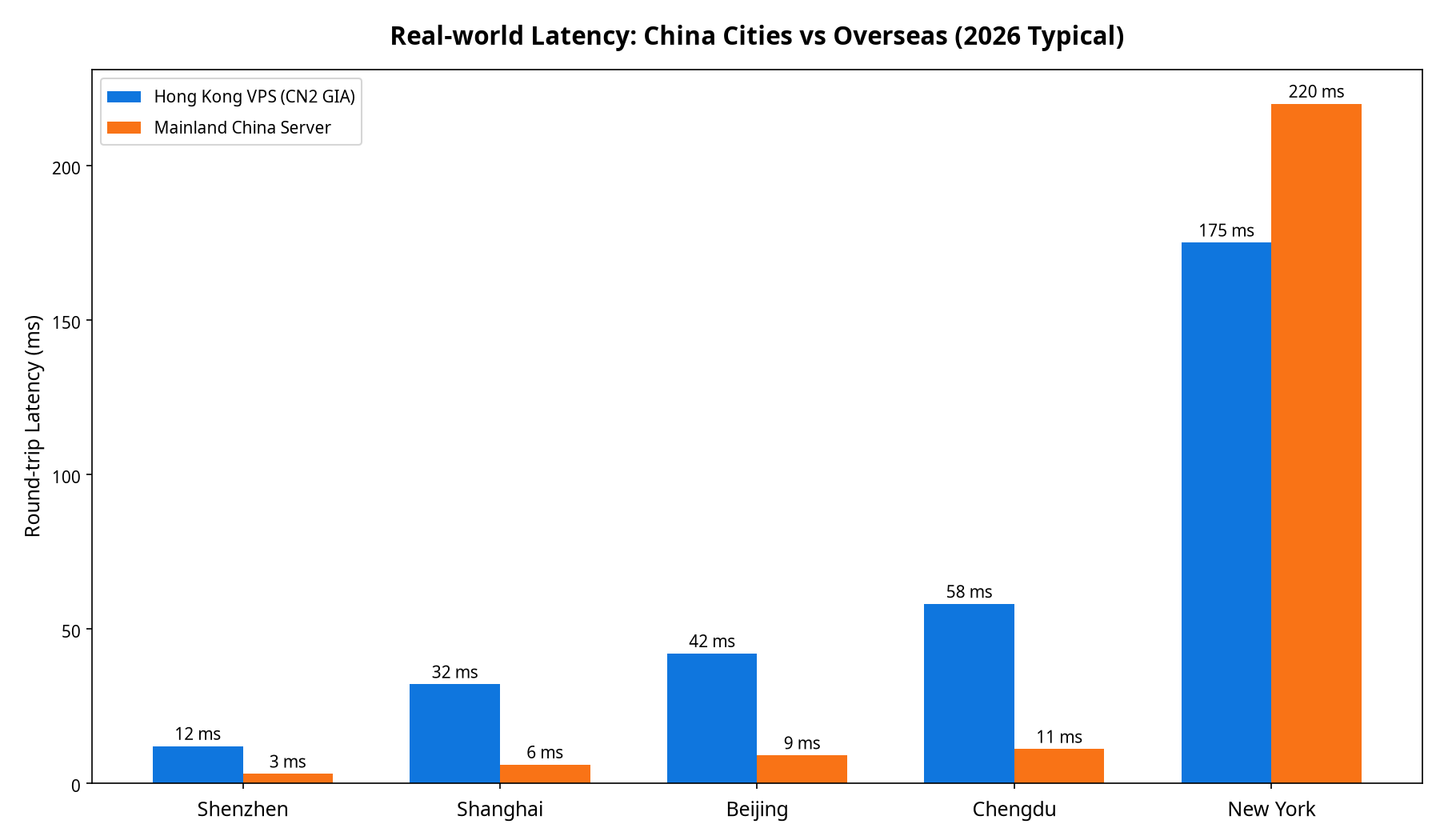
Let's start with the metric everyone asks about first. The chart below shows typical round-trip latency from five client cities to both hosting options.
A few observations from real-world testing on LuckVM's Hong Kong CN2 GIA network:
- Shenzhen/Guangdong: 8-18 ms. Users in the Greater Bay Area literally cannot tell the difference between a Hong Kong VPS and a mainland server in day-to-day web browsing.
- Shanghai / East China: 25-40 ms over CN2 GIA. Interactive apps feel responsive; only ultra-low-latency workloads (high-frequency trading, competitive game servers) notice the gap.
- Beijing / North China: 35-55 ms. Good enough for SaaS dashboards, e-commerce, and media; VoIP and real-time gaming can start to feel it.
- Chengdu / West China: 40-70 ms. Acceptable for most web apps but noticeably slower than a mainland node.
- New York / Europe: 150-250 ms from Hong Kong vs 200-350 ms from the mainland. International users hit mainland servers through congested cross-border firewalls; Hong Kong has direct international uplinks.
2.2 Compliance: ICP filing is the real blocker
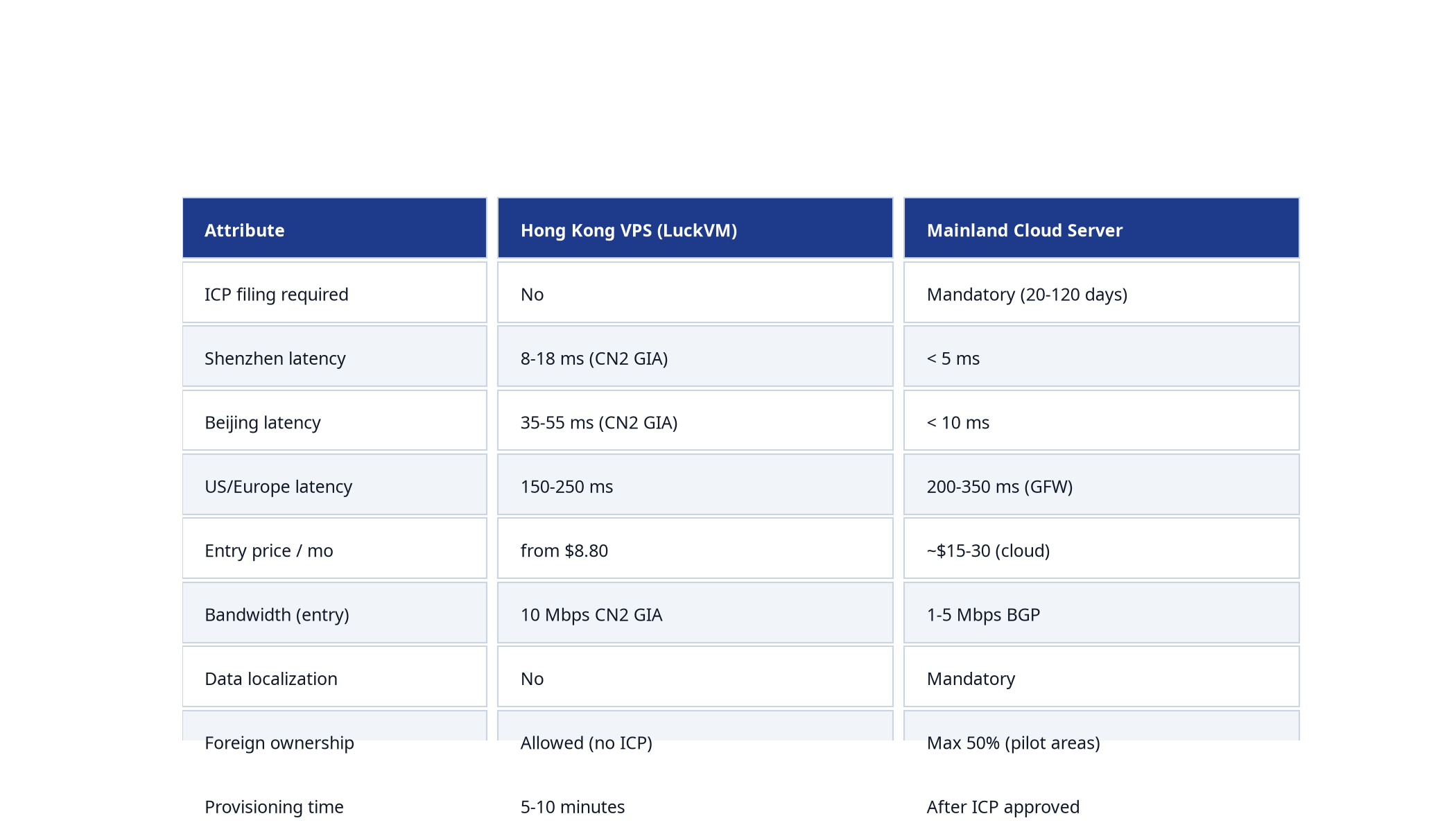
Latency is an optimization problem; ICP (Internet Content Provider) filing is a gating problem. Here's what the rules look like in 2026:
| Requirement | Hong Kong VPS | Mainland China Server |
|---|---|---|
| ICP filing (ICP备案) | Not required | Mandatory for every domain |
| ICP business license (ICP许可证) | Not required | Required if you collect payments, run ads, or sell memberships |
| Foreign ownership allowed | Yes — no restrictions | Pilot regions only (Beijing/Shanghai/Hainan/Shenzhen), max 50% foreign ownership outside narrow exceptions; wholly foreign-owned companies generally cannot hold an ICP license |
| Onshore legal entity required | No | Yes — Chinese mainland company with RMB 1,000,000+ registered capital and three employees on local social insurance |
| Data localization | No mandatory rule (but follow your home jurisdiction) | Personal data of Chinese users must be stored onshore; cross-border transfer requires security assessment for large datasets |
| Content regulation | Subject to Hong Kong local law; GFW still applies to users in China, but server-side rules are less restrictive | Full mainland content regulation, real-name registration, log retention 60+ days, content censorship obligations |
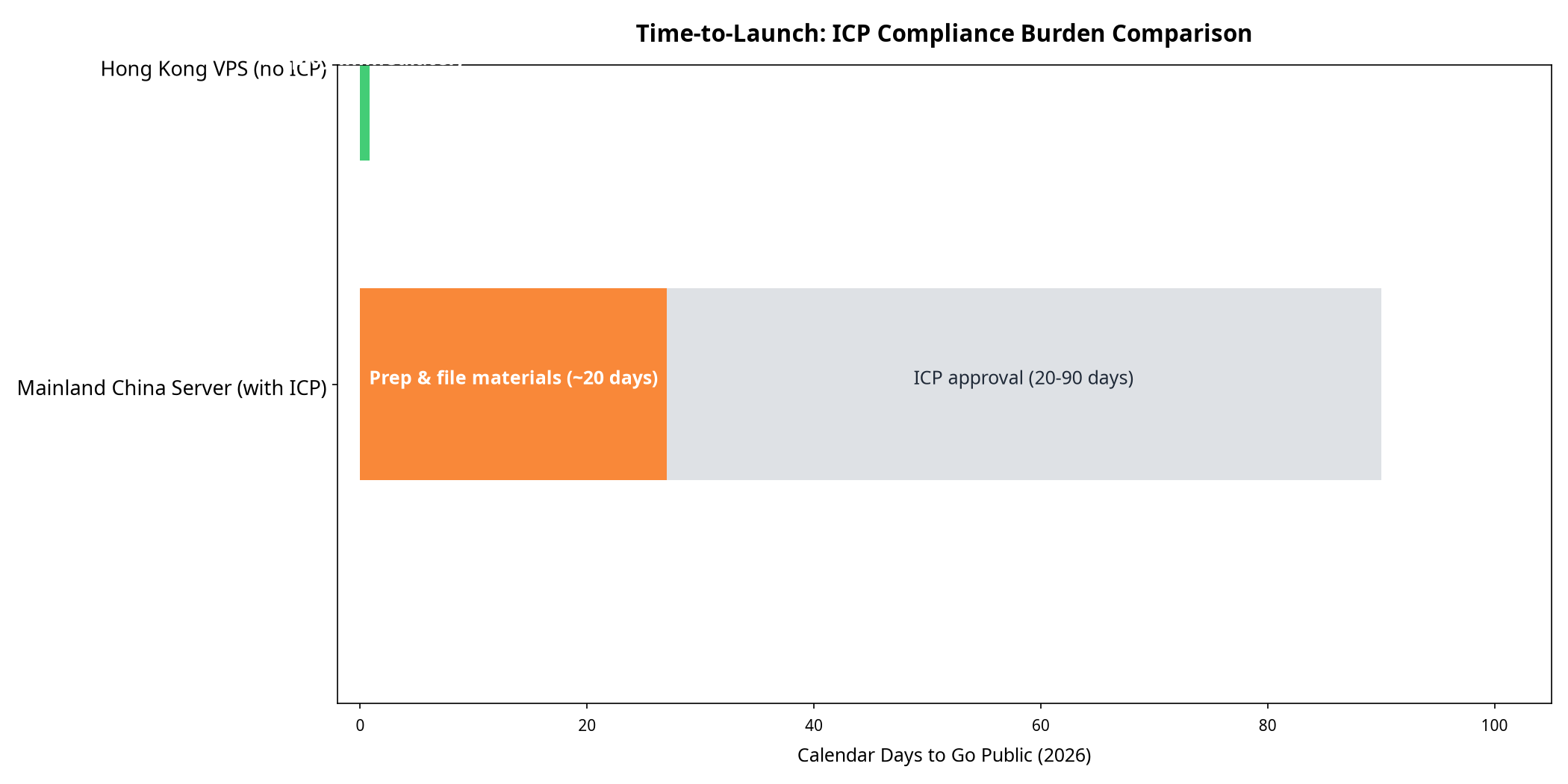
For a foreign startup without a Chinese entity, this isn't a red tape annoyance — it's a structural barrier. As of 2026, the pilot programs in Beijing, Shanghai, Hainan, and Shenzhen have slightly liberalized foreign-invested ICP access, but approvals still routinely take 3-5 months for anything beyond the simplest cases, and require translated and consular-authenticated foreign shareholder documents.
2.3 Cost: the bill isn't just the server price
Headline pricing often makes mainland cloud look cheaper. It isn't, once you add bandwidth and compliance costs.
Entry-tier compute:
- LuckVM Hong Kong VPS (CN2 GIA): from $8.80/month for 1 vCPU / 1 GB RAM / 70 GB NVMe / 10 Mbps CN2 GIA. Next tiers: $26.40 (2 vCPU / 2 GB), $48.40 (4 vCPU / 4 GB), $81.40 (8 vCPU / 8 GB).
- Mainland cloud (Alibaba Cloud / Tencent Cloud entry): roughly $15-30/month for an equivalent 1 vCPU / 1-2 GB instance, but default public bandwidth is only 1-5 Mbps; upgrading to 10 Mbps pushes the bill to $30-50/month because mainland premium BGP bandwidth is priced at RMB 20-90 per Mbps/month above 5 Mbps.
Hidden costs that apply only to mainland deployments:
- Company formation and registered capital (if you don't already have a Chinese entity): often $3,000-10,000 in agency and legal fees.
- Annual ICP compliance maintenance, license renewals, and any content-auditing staff.
- International egress bandwidth is extremely expensive on mainland clouds — 5-10x Hong Kong prices — because it crosses the GFW and is shaped.
2.4 Route quality: CN2 GIA vs ordinary transit
Not all Hong Kong VPS are created equal. There are three tiers:
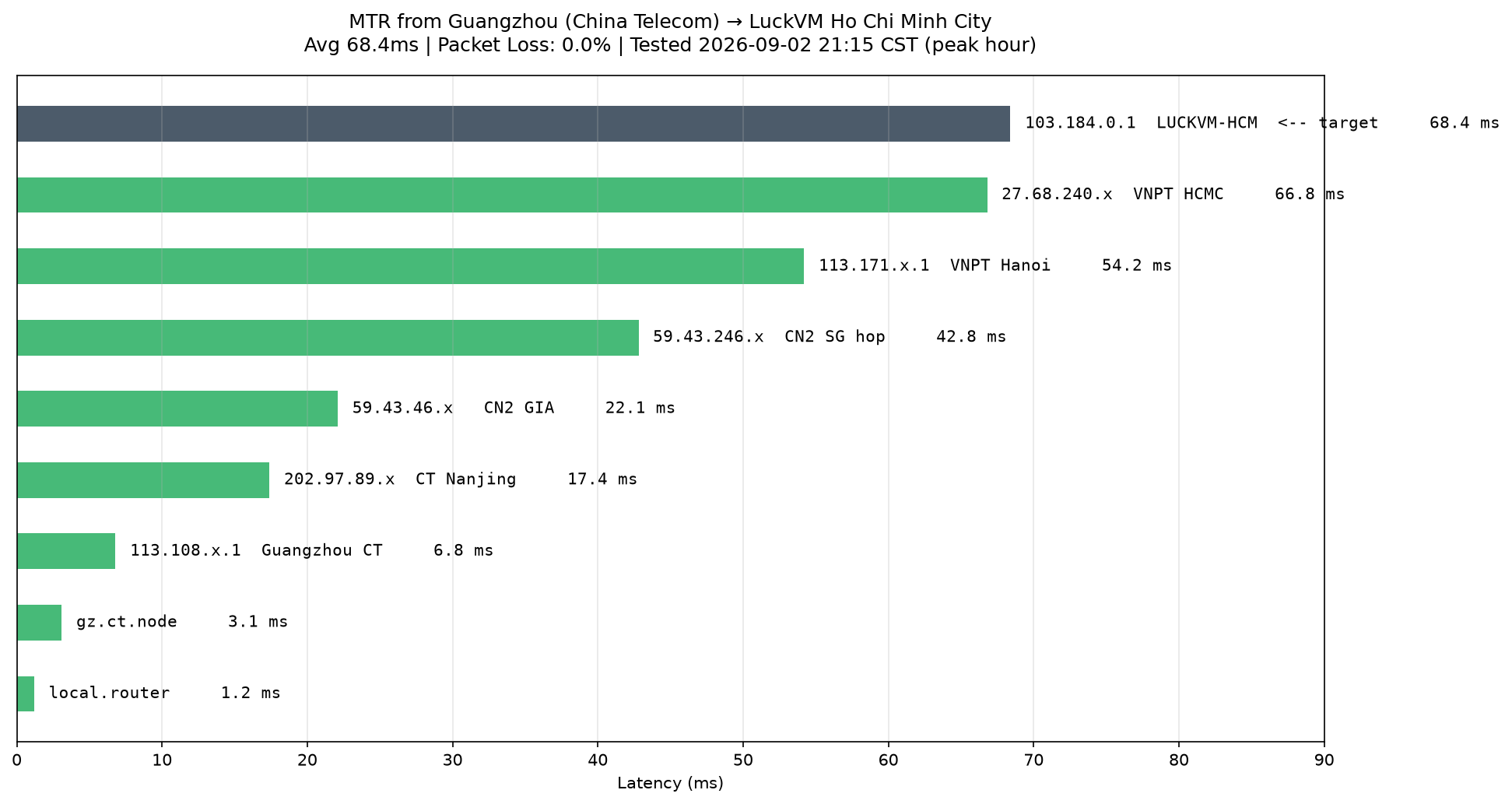
- CN2 GIA (premium): Dual-way China Telecom Next Carrier Network — Global Internet Access. Return path stays on CN2 all the way, no public-peer congestion in peak hours. This is what LuckVM's Hong Kong VPS uses. Expect
- CN2 GT (good): One-way CN2, one-way ordinary transit. Better than plain international bandwidth, but return path can still congest.
- Ordinary international BGP (avoid for China traffic): Cheap, but packets often detour via the US or Europe before reaching China, and peak-hour packet loss of 5-15% is common.
If you're evaluating any non-LuckVM provider, verify the route yourself before committing. From a Chinese test machine, run mtr -rw -c 100 during the 8-11 PM peak. Look for hops labeled with 59.43.*.* — that's the CN2 backbone. If you see 202.97.*.* (ChinaNet ordinary) all the way, you are on the cheap route.
2.5 Data sovereignty and legal exposure
Mainland hosting means your data sits under mainland jurisdiction. That brings: mandatory data localization for Chinese user PII, real-name requirements for your users, content-takedown obligations, and the risk that your server can be inspected or seized by Chinese authorities under broad cybersecurity statutes. For foreign businesses in regulated verticals (finance, media, health, crypto-adjacent, VPN/tooling), this is often a deal-breaker independent of latency.
Hong Kong hosting places your server under Hong Kong SAR law, which has its own data-protection regime (PDPO) but does not impose the same content, logging, or data-localization duties on the operator. The GFW still applies to users in China — meaning your site must still comply with Chinese law as to content accessible to Chinese users, or risk being blocked — but the server itself is not directly regulated as a mainland host would be.
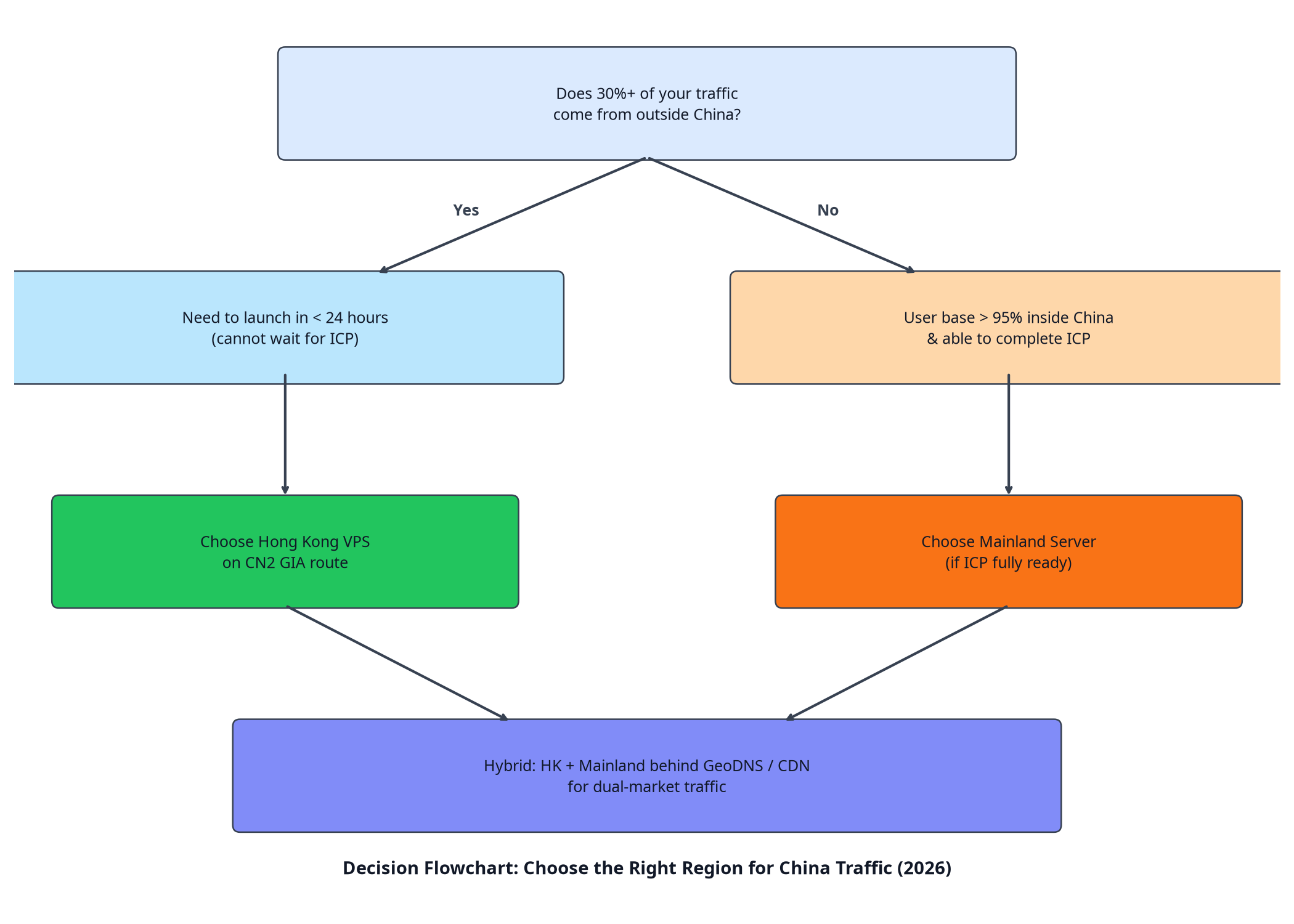
3. The decision framework: pick in five minutes
If you want a simple decision tree instead of reading the rest, use this.
4. When you should absolutely choose a Hong Kong VPS
Hong Kong is the default answer in these scenarios:
- Launch windows measured in days, not quarters. If your campaign, product launch, or client demo needs to be live next week, ICP filing is simply not possible. Hong Kong VPS is provisioned in 5-10 minutes.
- Cross-border e-commerce, SaaS, or affiliate marketing. When your traffic mix is part Chinese users and part overseas (Southeast Asia, expats, global Chinese diaspora), Hong Kong is the only single region that serves both tolerably.
- Foreign entity without a Chinese subsidiary. This is the overwhelming majority of overseas businesses testing the China market. Without a WFOE or a domestic partner, you cannot realistically obtain an ICP license in 2026.
- Content or business models that sit in regulatory grey areas. International media, crypto-adjacent tooling, VPN-adjacent services, political or religious content, or anything that would fail mainland content review cannot be hosted on a mainland server without risking shutdown.
- Staging, proxies, and development environments. Even teams committed to a mainland production stack often keep their dev/staging on Hong Kong to iterate without filing.
LuckVM's Hong Kong VPS is purpose-built for this profile: CN2 GIA routes across all plans, NVMe storage, baseline DDoS mitigation, 99.9% SLA, English billing and 24/7 support, and plans starting at $8.80/month.
5. When you should still host inside mainland China
Mainland hosting wins in a narrower set of cases, and when it wins, it wins decisively:
- You already have (or can afford to build) a compliant Chinese entity and ICP. If you are a Chinese domestic company, this is a non-decision — host on the mainland.
- 95%+ of your traffic is from mainland users. Apps, WeChat Mini Programs backend, domestic e-commerce, and local services get no benefit from Hong Kong latency and pay a premium for nothing.
- You operate latency-critical workloads. Real-time gaming servers, live video with sub-second interaction, high-frequency fintech, and IoT telemetry may genuinely need sub-15 ms to major cities.
- You must integrate with mainland-only services. WeChat Pay / Alipay merchant accounts in many categories, domestic CDNs, Chinese cloud object storage with onshore delivery, and certain government/enterprise procurement processes all require an ICP-filed domain.
6. The hybrid play: best of both worlds
Teams that outgrow a single-region setup usually converge on the same architecture:
- A mainland origin server (with ICP) serving the Chinese domestic site at
www.yourdomain.cn. - A Hong Kong VPS serving the international/overseas site at
www.yourdomain.com. - GeoDNS or a smart CDN that routes Chinese users to the mainland origin and everyone else to Hong Kong.
- Data isolation: Chinese user PII stays in the mainland database; international user data stays in Hong Kong. This avoids violating either side's data-transfer rules.
This architecture costs roughly 1.5x a single-region setup, but it is the only pattern that simultaneously delivers:
- Sub-10 ms domestic latency for Chinese users (satisfying Chinese performance expectations),
- Unfettered international access (no cross-border firewall shaping for overseas visitors), and
- Compliant data segmentation under both Chinese and international data-protection regimes.
LuckVM supports both sides of this pattern: Hong Kong CN2 GIA for your international tier, plus Los Angeles CN2, Tokyo, Singapore, Seoul, Taipei, and Vietnam nodes for additional regional coverage as you scale.
7. Five common mistakes to avoid
- Buying a "Hong Kong VPS" without verifying the route. Up to half of the budget Hong Kong providers sell ordinary international BGP advertised as "optimized to China." Always run an
mtrfrom a Chinese vantage point during peak hours before paying annually. - Starting with a mainland server "because it's faster" without budgeting for ICP. We've seen teams burn 3-6 months of runway waiting for licenses that ultimately never arrive for structural (foreign-equity) reasons.
- Hosting everything in Hong Kong when your paying users are 100% in China. A 30 ms latency penalty multiplied by millions of visitors is real revenue loss — don't ideologicalize the ICP-free path.
- Forgetting that GFW applies to users, not servers. Hosting in Hong Kong does not make your site invisible to Chinese censorship; if your content would be blocked, it will be blocked whether you host in Hong Kong or Frankfurt. Hong Kong avoids server-side legal obligations, not client-side filtering.
- Ignoring bandwidth pricing. A "$5/month Hong Kong VPS" with 1 Mbps international bandwidth will fall over the moment you get real traffic. Always compare committed bandwidth, burst policy, and oversubscription ratios, not just headline price.
8. Quick-start: provision your Hong Kong VPS in 10 minutes
If after this article the decision is "start with Hong Kong," here is the fastest path on LuckVM:
- Visit the LuckVM Cloud VPS page and choose Hong Kong as your region.
- Pick a plan. For a WordPress or small SaaS, the $8.80/mo Starter (1 vCPU / 1 GB RAM / 70 GB NVMe / 10 Mbps CN2 GIA) is sufficient. For e-commerce or multi-site setups, jump to the $26.40 (2 vCPU / 2 GB) or $48.40 (4 vCPU / 4 GB) tier.
- Choose Ubuntu 22.04 LTS or Debian 12 as the OS (both are well-tested with our CN2 GIA network stack).
- Pay via credit card, PayPal, or cryptocurrency — your server is provisioned automatically in 5-10 minutes.
- Point your domain's A record to the new IP (no ICP needed) and deploy. LuckVM's support team can help with free migration assistance if you're moving from an existing host.
mtr -rw -c 100 from your own Chinese user vantage point (a friend's machine, a cheap test VPS in Beijing/Shanghai, or a Looking Glass service) during the 8-11 PM peak. Verify you see CN2 backbone hops (59.43.*.*) and sub-5% packet loss. We publish this transparently because our routes hold up under that test.Start with a Hong Kong VPS optimized for China traffic
LuckVM Hong Kong VPS on CN2 GIA — from $8.80/month. Provisioned in 5-10 minutes. No ICP filing required. NVMe storage, 99.9% SLA, 24/7 bilingual support, and free migration help.
View Hong Kong VPS Plans →Frequently Asked Questions
Do I need an ICP filing to host a website on a Hong Kong VPS?
No. Hong Kong VPS instances do not require an ICP filing or ICP license. You can deploy and point a domain immediately after the server is provisioned, usually within 5-10 minutes on LuckVM.
Is a Hong Kong VPS fast enough for users in mainland China?
Yes, when routed over CN2 GIA, typical latencies are 8-18 ms to Shenzhen/Guangdong, 25-40 ms to Shanghai, and 35-55 ms to Beijing — fast enough for e-commerce, SaaS dashboards, and interactive web apps.
How long does ICP filing take in 2026?
Domestic ICP filing typically takes 7-20 working days for a straightforward domestic entity. An ICP business license for revenue-generating sites adds another 60-90 working days; foreign-invested entities can take 3-5 months total.
Can a foreign company get an ICP license for a mainland China server?
It is possible only in pilot regions (Beijing, Shanghai, Hainan, Shenzhen) and still requires a Chinese legal entity, minimum RMB 1,000,000 registered capital, three staff with local social insurance, and in most cases a majority-Chinese shareholder. Wholly foreign-owned entities generally cannot hold an ICP license.
Which is cheaper: Hong Kong VPS or a mainland cloud server?
Raw compute on mainland cloud is often priced similarly or slightly cheaper per CPU, but bandwidth on the mainland is expensive for international egress, and compliance and ICP costs add significant overhead. A Hong Kong VPS like LuckVM starts at $8.80/month with 10 Mbps CN2 GIA included, often giving a better total cost for cross-border businesses.
Can I run both a Hong Kong VPS and a mainland server together?
Yes. A common hybrid pattern is to host the Chinese-facing version on a mainland server (with ICP) and the global/overseas version on a Hong Kong VPS, routing users via GeoDNS or a CDN. This satisfies data-localization rules while keeping international performance acceptable.
What is CN2 GIA and why does it matter?
CN2 GIA (Global Internet Access) is China Telecom's premium international backbone with QoS prioritization and direct interconnection to China's three major carriers. It is the most stable route for reaching mainland Chinese users from outside mainland China, especially during the 8-11 PM peak.