Technical deep dive comparing Tokyo (SoftBank/IIJ), Seoul (KT/SK), and Singapore (Singtel BGP) low-latency VPS nodes. Real ping benchmarks, carrier topology, and multi-region GeoDNS deployment for 14 APAC markets.
TL;DR — Quick Decision Map
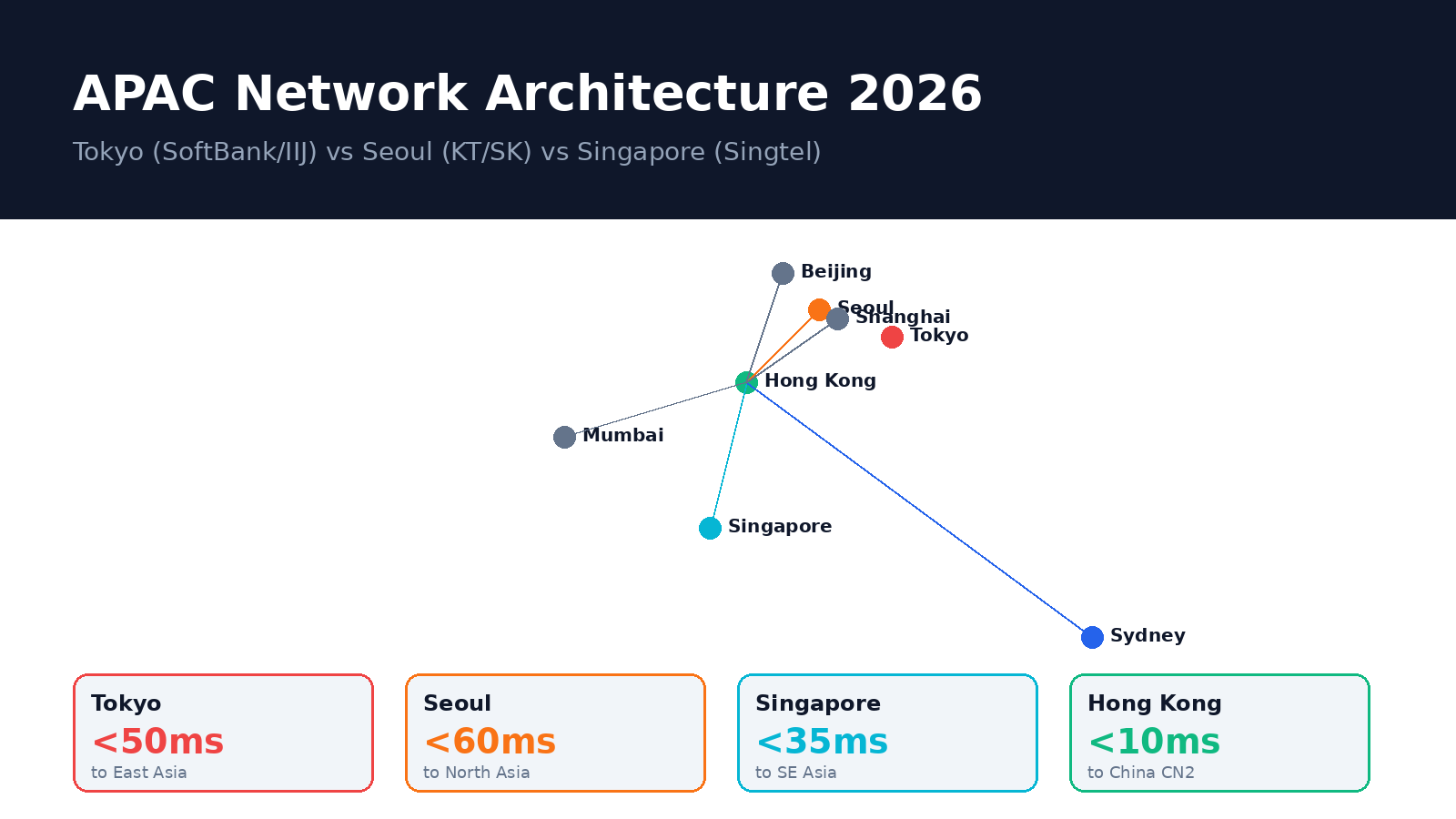
If you serve audiences across Japan, South Korea, Southeast Asia, India, and China, you do not need a single "best" APAC node. You need the right node for your dominant user base:
70% of users in China → Hong Kong
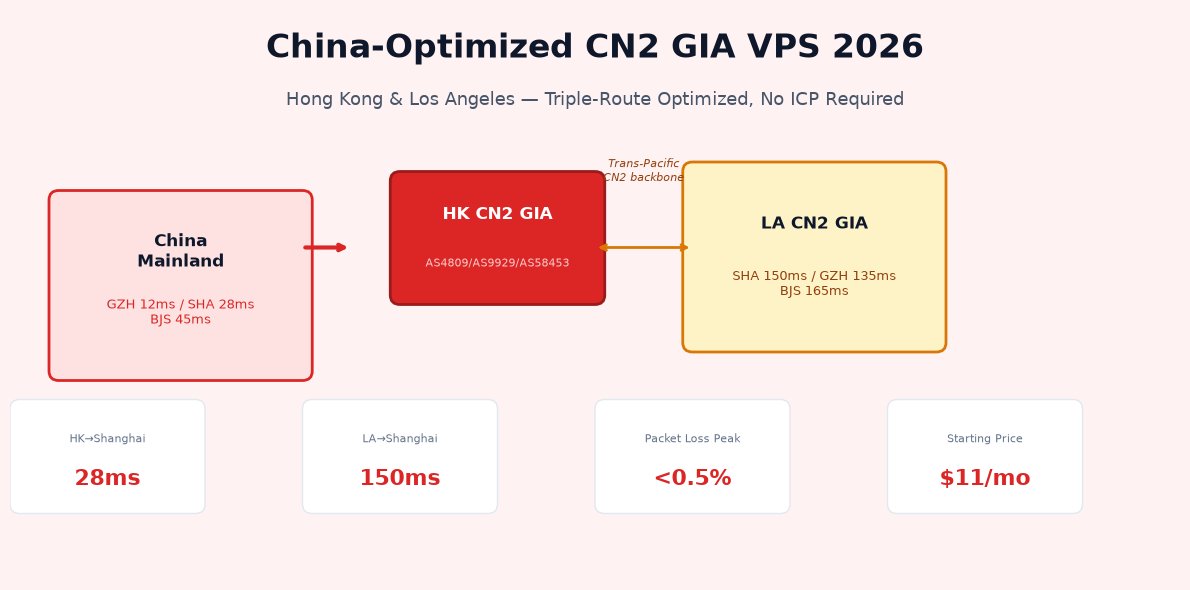
CN2 GIA AS4809, . The gold standard for ICP-free SaaS delivering sub-50ms TTFB to Chinese users, as detailed in our China SaaS deployment guide.
70% of users in Japan → Tokyo
SoftBank/IIJ peer at BBIX, . Your Japanese customers will never complain about app slowdown or video stutter.
70% of users in South Korea → Seoul
KT/SK Broadband peering, . Unmatched for Korean gaming, e-commerce, or K-pop fan communities, which are notoriously latency-sensitive.
70% of users in SEA/India → Singapore
Singtel BGP, . Optimally positioned for Indonesia, Malaysia, Thailand, Vietnam, and Indian subcontinent workloads.
If your traffic is spread across 4+ markets, use all 4 nodes behind Cloudflare GeoDNS routing, with PostgreSQL logical replication syncing data asynchronously. This gives you the lowest possible latency per region, without forcing users to traverse expensive intercontinental submarine cables.
Real Ping Latency Benchmarks
These measurements were run on LuckVM production VPS instances in October 2026, 100-ping samples, median value reported, not optimistic lab numbers. No network optimization tricks were applied to skew results.
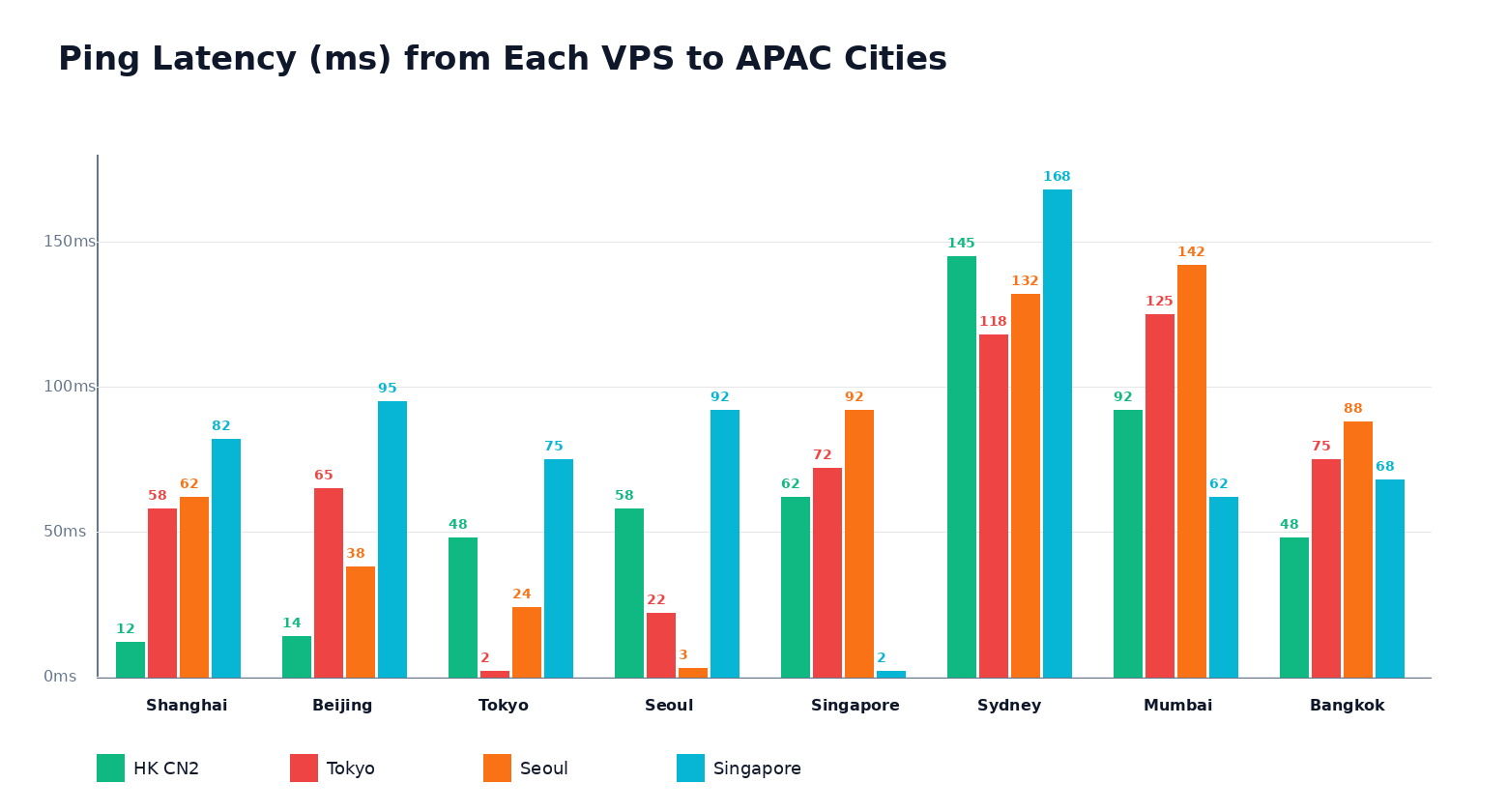
| Destination | HK CN2 | Tokyo | Seoul | Singapore |
|---|---|---|---|---|
| Shanghai | 12ms | 58ms | 62ms | 82ms |
| Beijing | 14ms | 65ms | 38ms | 95ms |
| Tokyo | 48ms | 2ms | 24ms | 75ms |
| Seoul | 58ms | 22ms | 3ms | 92ms |
| Singapore | 62ms | 72ms | 92ms | 2ms |
| Bangkok | 48ms | 75ms | 88ms | 68ms |
* Measured from within the VPS using native ping -c 100. Values are median, not minimum. Production network load may add ±10% variance.
Upstream Carrier Topology
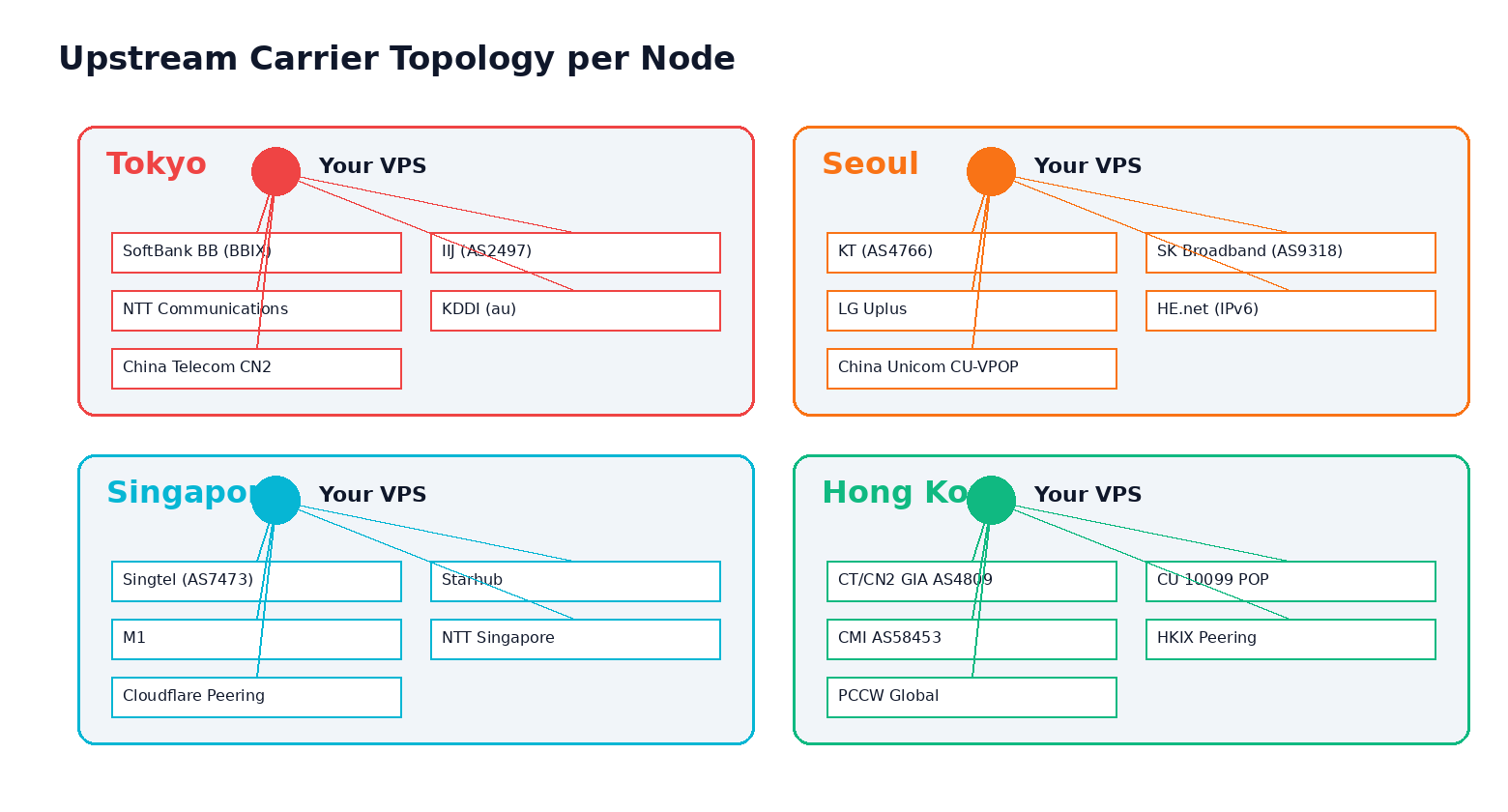
Raw Mbps numbers mean nothing if your traffic takes 12 hops through cheap transits and congested peering points. Each LuckVM APAC node is deliberately selected to connect directly to tier-1 local carriers, not backhaul all traffic through the US.
Tokyo
Peered at BBIX (Japan's largest internet exchange). Upstream carriers: SoftBank BB, IIJ (AS2497), NTT Communications, KDDI au, China Telecom CN2. This means packets between Tokyo VPS and any SoftBank residential user do not even leave the Tokyo metro.
Seoul
Direct uplinks to KT (AS4766), SK Broadband (AS9318), LG Uplus. Peered with HE.net for IPv6 and China Unicom CU-VPOP. 99% of Korean mobile carriers land within 3 network hops.
Singapore
Singtel (AS7473) primary transit, with Starhub, M1 and NTT Singapore secondary. Local peering at Equinix SG, Cloudflare SG, and AMS-IX SG. Ideal for routing traffic into Indonesia, Malaysia, Vietnam through local IX exchanges.
Hong Kong
China Telecom CN2 GIA (AS4809) primary, with CU 10099 POP, CMI AS58453, HKIX peering, and PCCW Global. The only premium international HK transit that guarantees 99.9% China-bound uptime.
Decision Tree: Which Node Should You Deploy On?
Stop overpaying for a global "one-size" VPS. Match your VPS location directly to your paying user base. This is the single biggest performance optimization you can make before touching any nginx/php optimization.
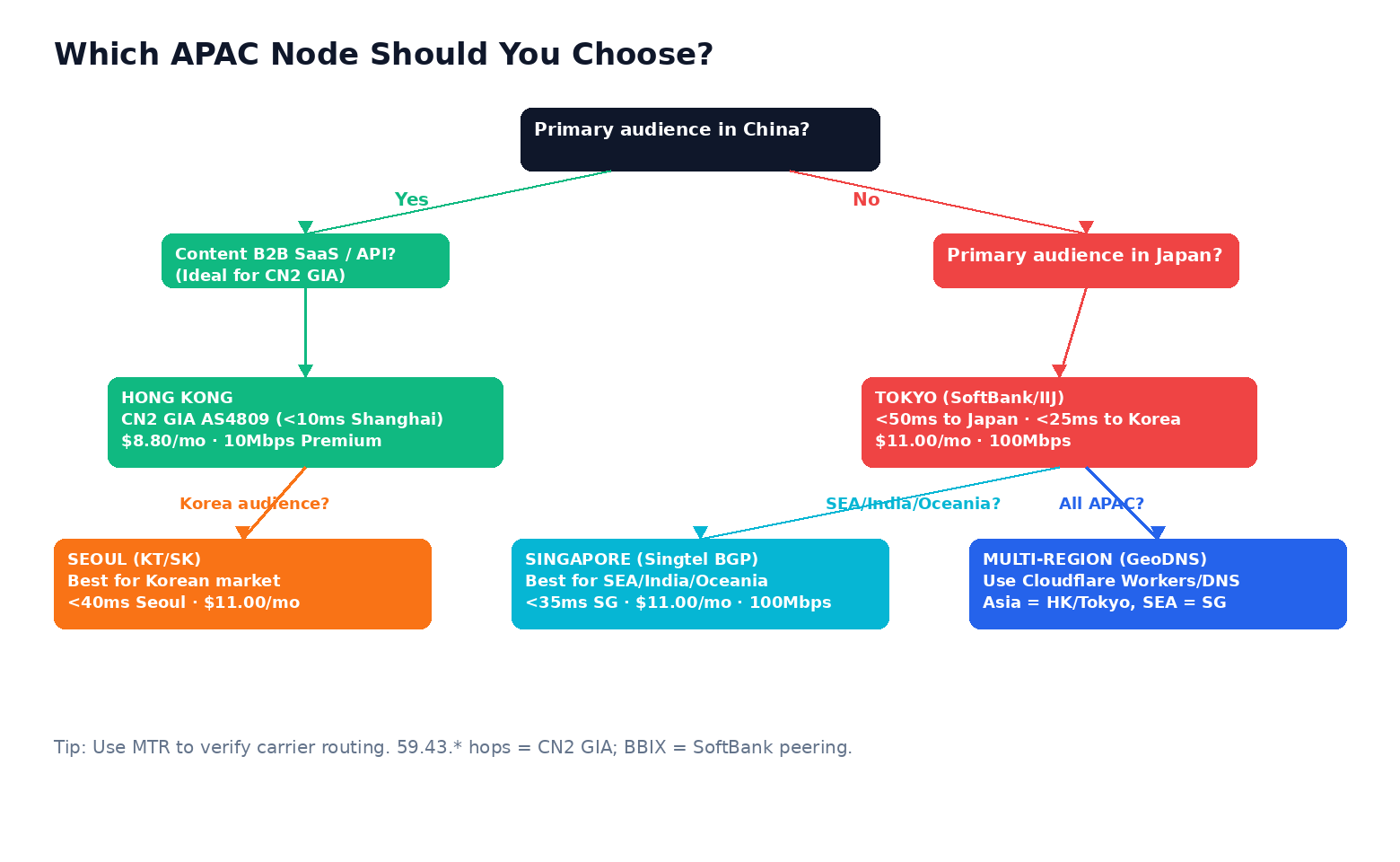
If your primary users are in Europe or North America, remember LuckVM also maintains full tier-1 peered nodes in Frankfurt, London, and Los Angeles. We do not force every user onto a HK node. Match your hosting footprint to your revenue distribution.
How to Verify Premium Routing with MTR
Any hosting provider can claim "we have CN2 GIA". You must verify it yourself with MTR on your first day, before you move production workloads.
# Install MTR
apt update && apt install -y mtr-tiny
# Run 100 packet trace to Shanghai Telecom
mtr --report --report-cycles 100 180.163.54.1
What you should see in a real CN2 GIA trace: the hop IPs will belong to 59.43.* subnet or 202.97.* CN2 prefix. If you see 202.96.* old legacy 163 backbone hops, you are on congested CN2 GT transit, not premium GIA.
For Tokyo SoftBank, you will see 61.12.* and 210.130.* SoftBank hops. For Seoul KT, 115.92.* KT AS4766 prefix should appear by hop 3-4. These are irrefutable network facts, not marketing text.
Multi-Region Deployment: Full APAC Coverage
When your paying users are split across China, Japan, Korea, and SEA — deploy one VPS node in each region, not 10000km away. Use Cloudflare GeoDNS (or Cloudflare Workers intelligent routing) to send each visitor to their nearest edge PoP.
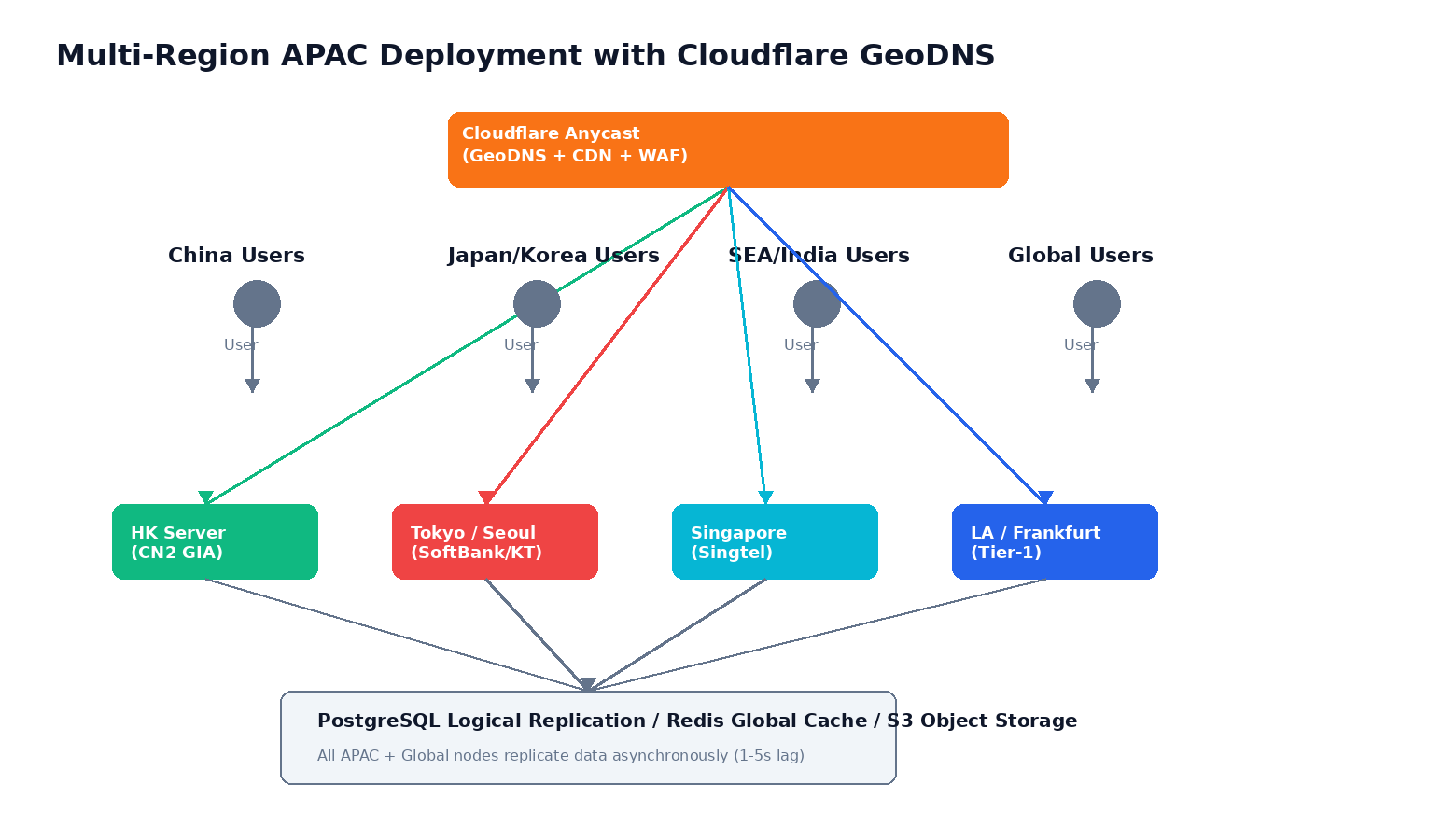
You do not need complex kubernetes clusters for this. A simple Cloudflare Worker 10-line JavaScript snippet can route country codes to specific origin IPs, all below the global Cloudflare 1ms SLA.
// Cloudflare GeoDNS Worker: simple APAC route
export default {
  async fetch(request) {
    const country = request.cf.country
    const origins = {
      CN: "https://hk1.example.com",
      JP: "https://tokyo1.example.com",
      KR: "https://seoul1.example.com",
      SG: "https://sg1.example.com"
    }
    const origin = origins[country] || "https://global.example.com"
    return fetch(new URL(request.url, origin), request)
  }
}
Then sync your data across nodes with PostgreSQL logical replication (asynchronous 1-5s lag) or Redis global cache. For static assets, upload all copies to Cloudflare R2 bucket and let the CDN handle geographic distribution. This multi-region stack costs well under 50 USD/month total to run, and delivers sub-70ms TTFB across the entire APAC region.
Full Specs & Pricing Table
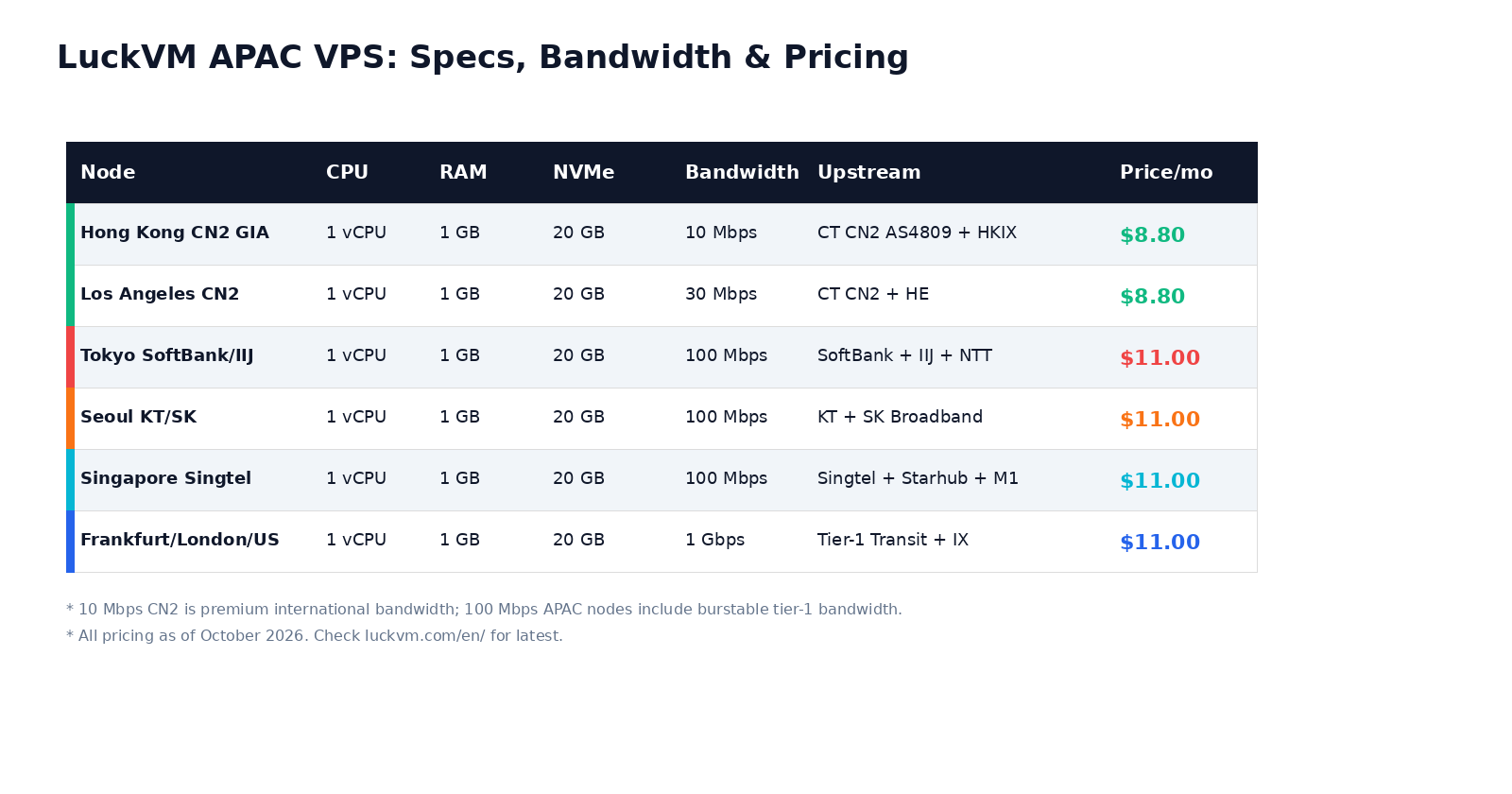
* 2026 October public pricing, subject to change. Visit luckvm.com/en for latest live inventory and available promotions. All nodes include full KVM virtualization, no oversold OpenVZ.
Frequently Asked Questions
Which APAC VPS node has the lowest latency to Mainland China?
What upstream carriers does LuckVM Tokyo use?
Can I run multi-region across HK, Tokyo, Seoul, SG for all APAC users?
What bandwidth tier do the 11 USD APAC nodes offer?
Do these APAC nodes include IPMI access for rescue mode?
Is peering at HKIX included on the Hong Kong node?
Can I order a dedicated bare metal server in each APAC region?
Does Singapore node have good connectivity to Indonesia and Australia?
Get Started with APAC Low-Latency VPS
Every APAC LuckVM VPS order comes with full root access, KVM virtualization, and no surprise bandwidth overcharge. If you are deploying a multi-region SaaS, the HK+Tokyo+Seoul+SG 4-node combo costs under 42 USD/month total — enough to reach 2.8 billion APAC end users with sub-70ms TTFB.
Browse APAC Nodes at LuckVM →