Many users who purchase a US server have experienced the same problem: the website loads quickly during the day, but after around 8 PM, everything starts to slow down. Remote connections become noticeably laggy, pages take longer to load, and occasional disconnections may even occur.
The server page clearly says “CN2”, yet the actual experience is far from what was expected.
In many cases, the problem comes down to the network route.
CN2 is not a single network product that can fully describe network quality. CN2 GT and CN2 GIA are different network products, while standard international BGP can also involve different combinations of upstream carriers. Even when two servers are located in the same data center, their network routes can produce very different results during peak hours.
Here is a quick comparison:
| Network Type | Main Characteristics | Performance for Mainland China | Suitable For |
|---|---|---|---|
| Premium CN2 | Based on CN2 GIA with additional multi-carrier optimization | Low latency and relatively stable during peak hours | E-commerce, gaming, enterprise applications |
| CN2 GIA | Uses CN2 backbone routes for both directions in typical configurations | Lower latency and better packet-loss control | Websites, APIs, remote work |
| CN2 GT | Uses CN2 for some domestic segments, while international traffic may use 163 routes | Usually fast, but more susceptible to peak-hour congestion | Personal websites, testing environments |
| Standard International BGP | Multi-carrier international connectivity | Routing and cross-border stability depend heavily on the actual route | Global websites, budget projects |
From a practical perspective, choosing a US server should start with where your users are located, followed by the network route. Simply looking for the word “CN2” is not enough..jpg)
1. Standard International BGP: Affordable, but Routing Matters
International BGP essentially refers to connectivity between multiple network carriers.
One of its biggest advantages is broad global coverage. US data centers can connect to different carriers through BGP and select routes based on network conditions, making this type of connectivity suitable for international users.
For users in mainland China, however, the situation is more complicated.
Traffic traveling from China to a US server needs to cross international networks. Standard BGP routes may use traditional international networks such as China Telecom's 163 backbone. During evening peak hours, increased traffic on certain international gateways can cause latency and packet loss to rise.
For example, a Los Angeles server might deliver around 160 ms latency from Guangzhou during the daytime, while latency could increase to 200 ms or higher in the evening.
The exact result depends on the ISP, data center, upstream carrier, and current routing conditions.
For websites primarily serving users in North America, Europe, or other overseas markets, standard BGP can be perfectly adequate.
It is also a common choice for personal websites and budget-conscious projects.
2. CN2 GT: It Says CN2, but the Experience Can Still Be Different
CN2 GT is commonly found on relatively affordable US servers.
It belongs to the ChinaNet Next Carrying Network ecosystem and uses CN2 connectivity on certain domestic segments, while international traffic may still pass through traditional 163 backbone routes.
This is one of the main reasons people confuse CN2 GT with CN2 GIA.
Seeing “CN2” on a server product page can easily create the impression that the entire route uses premium CN2 connectivity. The actual routing configuration needs to be checked.
When network conditions are good, CN2 GT can still perform very well. During evening peak hours, however, congestion on the international segment can have a noticeable effect on latency and packet loss.
For example, LuckVM offers US West Coast server options with optimized connectivity for users accessing from mainland China. However, the actual experience for China Telecom, China Unicom, and China Mobile users can differ depending on the return route, so the network should ideally be tested from the relevant ISP before making a long-term decision.
The main advantage of CN2 GT is cost.
Because it is generally less expensive than CN2 GIA, it can make sense for personal blogs, company websites with limited traffic, development environments, and testing projects.
For applications that depend heavily on real-time connections or receive substantial mainland China traffic during the evening, CN2 GIA is usually worth considering.
3. CN2 GIA: The Main Advantage Is Network Quality
CN2 GIA stands for Global Internet Access.
Its main distinction from CN2 GT is the network resources and routing quality available for international connectivity. Typical GIA configurations use higher-grade CN2 network resources for cross-border traffic, which can provide more consistent performance.
This is why CN2 GIA is often positioned as a premium network option for US servers.
For users in mainland China, latency is only one part of the equation.
Packet loss during peak hours, routing stability, and jitter can have an even greater impact on actual usability.
For example, a US West Coast server may typically deliver latency in the range of roughly 130 to 180 ms from mainland China. The actual number depends on the user's city, ISP, data center, and routing path.
During evening peak hours, standard international routes may experience significant fluctuations, while a well-engineered GIA route can generally maintain a more consistent connection.
The difference becomes particularly noticeable with interactive applications.
A website administration panel may generate frequent requests to the server. Cross-border e-commerce platforms often rely heavily on APIs. Remote developers depend on SSH or Remote Desktop. Gaming and voice applications are even more sensitive to packet loss and jitter.
For these workloads, network stability matters much more than it does for a simple content website.
That is where the additional cost of CN2 GIA becomes easier to justify.
4. Premium CN2: Better Suited to Network-Sensitive Businesses
Premium CN2 services are generally built around CN2 GIA and may combine additional carrier resources for better multi-ISP connectivity.
Some providers integrate China Telecom CN2, China Mobile CMI, and other network resources, then optimize routing based on the user's ISP.
The goal is straightforward: provide users from different Chinese carriers with a more consistent cross-border connection.
Naturally, this type of network costs more.
If you are running a personal blog with only a few tens of thousands of page views per month, paying a substantial premium for a higher-end route may not provide much practical value.
For cross-border e-commerce, enterprise ERP systems, online applications, or services that require persistent connections, the situation is different.
Imagine an e-commerce backend processing orders, inventory updates, and API requests throughout the evening. A few minutes of network instability can result in API timeouts.
The same applies to remote development teams that rely on SSH, Remote Desktop, and video conferencing.
In these cases, network quality becomes part of the infrastructure cost of the business.
Some premium CN2 products from providers such as Raksmart are positioned specifically around optimized connectivity for users in mainland China. However, the exact route, bandwidth configuration, and actual performance should always be verified against the current product specifications and real-world testing.
5. Why Can Two “CN2” Servers Perform So Differently?
This is one of the easiest traps to fall into when purchasing a US server.
The term “CN2” alone does not tell you everything.
Actual performance can depend on the specific CN2 product, inbound and return routes, the user's ISP, upstream carriers, and the data center's network resources.
I recommend changing the order in which you evaluate a server.
Start by identifying your target users.
If most users are in the United States or Europe, standard BGP may already be sufficient.
If a large percentage of users are in mainland China, check the return routes for China Telecom, China Unicom, and China Mobile.
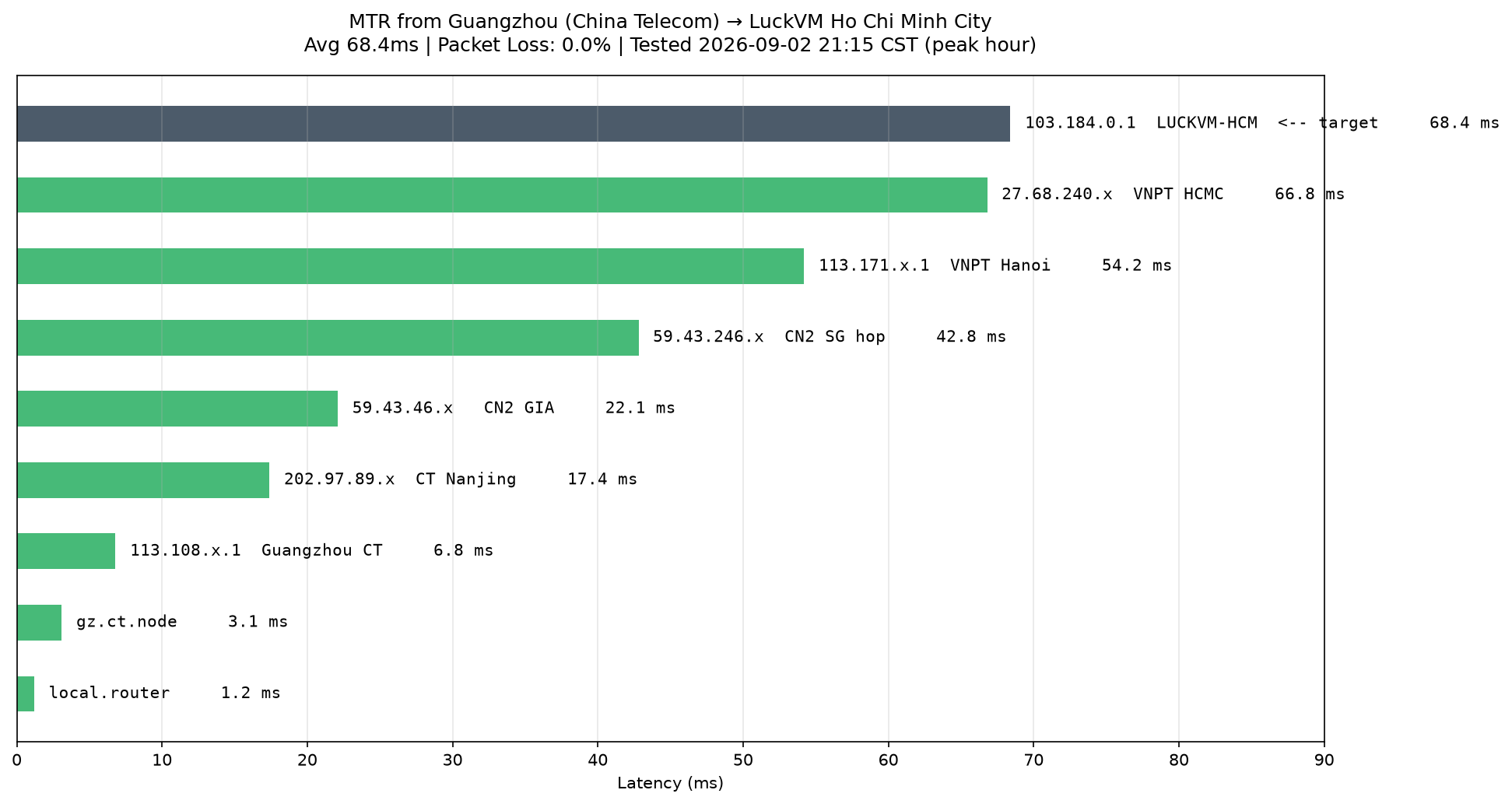
Then test the server during peak hours.
A fast daytime result only tells you that the network is performing well at that particular moment. Testing between approximately 8 PM and 11 PM is much more useful when evaluating cross-border connectivity.
Finally, consider price.
CN2 GIA and premium CN2 generally cost more because the network resources are more expensive. If your application has relatively modest network requirements, CN2 GT or standard BGP may offer better value.
For a business-critical application, however, network costs should be considered part of the overall operating budget.
6. Which Network Should You Choose for a US Server?
The choice becomes fairly straightforward when you look at actual use cases.
Personal blogs, testing websites, and basic company websites can usually start with standard BGP or CN2 GT. If the budget is limited, CN2 GT can provide a useful balance between price and connectivity to mainland China.
Corporate websites, cross-border e-commerce platforms, APIs, and websites with a large mainland China audience are better candidates for CN2 GIA. The higher price can be justified when peak-hour stability matters.
Gaming, remote work, video conferencing, and other latency-sensitive applications may benefit from premium CN2. This becomes especially relevant when the server needs to serve a large number of users in mainland China.
There is one more detail worth mentioning.
When purchasing a US server, try to ask the provider for a real test IP.
Test it separately through China Telecom, China Unicom, and China Mobile. Check both the outbound and return routes, then monitor latency, packet loss, and jitter during evening peak hours.
Those results are far more useful than simply relying on marketing terms such as “CN2,” “high-speed network,” or “China optimized.”
Final Thoughts
The most important thing to understand is that CN2 is not a guarantee of identical network performance.
CN2 GT, CN2 GIA, premium CN2, and standard international BGP can produce very different results, especially during peak hours.
If your users are primarily overseas, standard BGP may already provide excellent value.
If mainland China is an important market, CN2 GT can be a cost-effective option for lighter workloads, while CN2 GIA makes more sense when stability is critical.
For demanding applications, premium multi-carrier CN2 can provide an additional layer of network optimization.
The best choice ultimately depends on your users, application, budget, and tolerance for network fluctuations.
When choosing a US server, don't focus only on what the provider calls the route. Test what your users actually experience during the busiest hours of the day.