Quick TL;DR: Vietnam is the fastest-growing internet market in Southeast Asia — 100 million people, 70+ million internet users, and one of the highest e-commerce growth rates in the world. A Vietnam VPS gives you sub-50ms latency to local Vietnamese users, 28-72ms to neighboring SE Asian countries, and decent connectivity to southern China. But the local market is fragmented, most providers are Vietnamese-only, and truly premium BGP networks are surprisingly rare.
1. Why Choose a Vietnam VPS?
Vietnam has been flying under the radar compared to Singapore or Hong Kong, but it's quietly become one of the most important hosting markets in Southeast Asia. Here's why people are choosing Vietnam VPS in 2026, and when it makes more sense than its neighbors.
Five reasons people pick Vietnam
1. Direct access to 100M Vietnamese users. Vietnam's internet penetration is above 78% and still growing fast. The country has an incredibly young, mobile-first internet population. If you're serving Vietnamese users, hosting locally gives you 5-20ms latency to major cities — compared to 28ms from Singapore and 54ms from Hong Kong. That's a massive difference for web performance and mobile app responsiveness.
2. Excellent regional reach for Mekong Delta and southern ASEAN. A Vietnam VPS doesn't just serve Vietnam — it also provides great latency to Cambodia (20-30ms), parts of Thailand (50-70ms), and decent connectivity to southern China (Guangxi/Yunnan, 40-70ms). If your business covers the southern Indo-China region, HCMC is a smart choice.
3. Lower cost than Hong Kong or Singapore. Premium BGP Vietnam VPS is generally cheaper than HK or Singapore for comparable specs. Local Vietnamese providers offer aggressive pricing (though you trade off international support and network quality). Power and data center costs are also lower in Vietnam than in SG/HK.
4. Less saturated market with unique IP ranges. Vietnam IPs are less commonly blocked by firewalls, anti-bot systems, and streaming services than heavily-used SG/HK IP blocks. For web scraping, social media automation, or accounts that need "fresh" IPs, Vietnam is a good option.
5. Local e-commerce and fintech boom. Vietnam has one of the hottest e-commerce and fintech scenes in SE Asia. Platforms like Shopee VN, Lazada VN, Tiki, Sendo, MoMo e-wallet, ZaloPay, and local game publishers (VNG, Garena Vietnam) are growing fast. If you're building for this ecosystem, a local VPS is basically mandatory for compliance, latency, and payment gateway access.
When should you NOT use a Vietnam VPS?
Vietnam is not the answer for every use case:
- Primary audience is China North/East: Vietnam to Beijing/Shanghai is 90-110ms even on premium routes — Hong Kong (30-50ms) or Japan (40-70ms) are better
- Primary audience is Europe/North America: Use US West or European data centers (180ms+ to EU, 190ms+ to US East — too slow for latency-sensitive apps)
- You need English-language customer support from a local provider: Most Vietnamese hosting companies operate entirely in Vietnamese, and English support is often limited or non-existent
- You need the absolute best regional hub for the entire SE Asia: Singapore remains the king here (600M users across all SEA at sub-70ms)
Latency reference from Ho Chi Minh City
| Target City | Typical Latency | Best For |
|---|---|---|
| Ho Chi Minh City | 1-5ms | Vietnam south |
| Hanoi | ~22ms | Vietnam north |
| Phnom Penh | ~20ms | Cambodia |
| Singapore | ~28ms | SE Asia hub |
| Kuala Lumpur | ~42ms | Malaysia |
| Bangkok | ~48ms | Thailand |
| Guangzhou/Nanning | ~68ms | South China |
| Jakarta | ~56ms | Indonesia |
| Hong Kong | ~54ms | HK + South China |
| Manila | ~72ms | Philippines |
| Taipei | ~78ms | Taiwan |
| Shanghai | ~82ms | East China |
| Tokyo | ~88ms | Japan |
| Beijing | ~98ms | North China |
| Seoul | ~112ms | Korea |
| Sydney | ~168ms | Australia |
| London | ~178ms | Europe |
| Los Angeles | ~192ms | US West |
| New York | ~268ms | US East |
2. Network Landscape: How Vietnam Internet Works
Vietnam's internet is dominated by three major state-affiliated carriers, plus a handful of smaller players. The quality and routing differences between them are significant.
2.1 The "Big Three" Vietnamese Carriers
| Carrier | ASN | Market Position | China Routing | Notes |
|---|---|---|---|---|
| VNPT (Vietnam Posts & Telecom) | AS45899 | Largest, state-owned, ~40% market share | Good CN2 GIA/CUII peering via HK PoP | Most premium international routes |
| Viettel | AS7552 | Military-owned, ~35% market share, fastest growth | Direct CMI peering, decent CN2 | Best domestic coverage |
| FPT Telecom | AS18403 | Private, ~18% market share | Routes via Singapore for most CN traffic | Good for SG-bound traffic, slower to CN |
Additionally, there are smaller providers like Vietnamobile (AS24434), CMC Telecom (AS45903), and SCTV, but they mostly focus on residential broadband.
For premium VPS hosting, the sweet spot is dual or triple BGP multi-homing with VNPT + Viettel. This gives you optimal domestic routing to all Vietnamese ISPs plus the best international paths. If a provider only peers with one carrier, some domestic users will see noticeably worse performance.
2.2 Key data centers in Vietnam
- Ho Chi Minh City (HCMC): The primary hosting hub — most carriers have major PoPs here. Data centers include VDC (Vietnam Data Communication), CMC Data Center, Viettel IDC Hoa Lac/Saigon, and FPT Data Center. Best for reaching the south and international links.
- Hanoi: Political and economic center of the north. Best for reaching northern Vietnam and southern China (Guangxi, Yunnan). Has direct cross-border links to Nanning, China.
- Da Nang: A smaller market, primarily for central Vietnam coverage. Rarely used for international-facing hosting.
Important note: HCMC has better international submarine cable connectivity (APG, AAE-1, SMW3, IA Unity cables all land near HCMC). Hanoi has better direct China links via land border. For most international businesses targeting both Vietnam and broader SE Asia/China, HCMC is the better choice.
3. China ↔ Vietnam Routing
If you're targeting Chinese users from Vietnam (or Vietnamese users from China), the routing makes a big difference. Here's how the three Chinese carriers reach Vietnam:
| Chinese Carrier | Typical Path to Vietnam | Premium Route | Typical Latency (Guangzhou) | Peak Hour Quality |
|---|---|---|---|---|
| China Telecom | Guangzhou → HK PoP → VNPT HCMC | CN2 GIA (AS4809) | 65-75ms (GIA) / 90-140ms (163) | Excellent / Congested |
| China Unicom | Guangzhou → HK → Viettel | CUII (AS9929) | 70-80ms (CUII) / 95-150ms | Excellent / Variable |
| China Mobile | Nanning → Hanoi (land cross-border!) or via HK | CMI (AS9808/58453) | 55-68ms (direct) | Very good |
One interesting thing about China Mobile routing to Vietnam: there are direct overland fiber links crossing the China-Vietnam border at Pingxiang (凭祥)/Dong Dang and Hekou (河口)/Lao Cai. When carriers use these land routes, latency can be as low as 45-55ms from southern China — faster than going through Hong Kong. However, these links have limited capacity and aren't used by all providers.
How to verify your route
As always, trust but verify. Run an MTR from a Chinese probe (use ping.pe or itdog.cn) and look at the ASNs:
Hop 7: 59.43.x.x AS4809 (CN2 GIA HK) 42ms
Hop 8: 113.171.x.x AS45899 (VNPT Hanoi) 54ms
Hop 9: 27.68.x.x AS45899 (VNPT HCMC) 67ms
Hop 10: 103.184.0.1 Target VPS 68ms, 0% loss
Signs you're on a bad route:
- Seeing AS4134 (ChinaNet 163) and hops going through the US or Europe before Vietnam (some cheap providers have terrible international routing)
- Hops through Singapore with long delays (FPT sometimes routes this way)
- Packet loss >2% during 8-11 PM China peak hours
4. How We Tested
Between August 31 and September 2, 2026, I tested or re-verified 8 Vietnam VPS providers (local Vietnamese and international). Here's the methodology:
Test locations:
- Guangzhou (China Telecom) — 100M residential fiber (southern China, closest to VN)
- Shanghai (China Unicom) — 200M business line
- Nanning (China Mobile, Guangxi) — closest major Chinese city to Vietnam border
- Bangkok, Thailand (local ISP) — SE Asia regional test
- Singapore (AWS ap-southeast-1) — SE Asia hub
- Los Angeles (AWS us-west-2) — US reach
Tests performed:
- 100-probe MTR from each test location (avg latency, packet loss, jitter)
- iperf3 bandwidth test during China/VN peak hours (8-11 PM Beijing/ICT time)
- UnixBench single-core benchmark
- fio random 4k read/write (IOPS)
- Geolocation check (confirming IP is actually in Vietnam, not a tunnel from SG/HK)
- IP reputation check (Spamhaus, AbuseIPDB, VirusTotal)
- Vietnamese streaming/service access tests (Zing TV, FPT Play, VTC Now)
- WordPress + k6 load test (100 concurrent users)
Important: All latency and bandwidth tests were run during peak hours. Testing at 3 AM gives meaningless numbers. I also tested from Nanning specifically because that's the Chinese city closest to Vietnam — the land-border route performance tells you a lot about a provider's direct China connectivity.
5. Eight Vietnam VPS Providers Compared
LuckVM Vietnam (Ho Chi Minh City)
Let me lead with our offering and its limitations. We operate a BGP multi-homed network in HCMC with VNPT + Viettel dual upstream and premium return routes to China (CN2 GIA for China Telecom, CUII for China Unicom, CMI direct for China Mobile).
What you get: AMD EPYC 7003+ processors, Samsung PM9A3 NVMe, BGP multi-line (VNPT+Viettel), premium China return routes, KVM virtualization, 500Mbps-1Gbps ports, 5Gbps baseline DDoS protection, 7×24 Telegram/Ticket/Line support (English + Chinese), 3-day refund.
Weaknesses: We don't currently have a Hanoi node (HCMC only); our brand is less known locally than Vietnamese providers; we don't offer Vietnamese-language support; we don't have domestic Vietnamese payment methods (MoMo/ZaloPay) yet; bandwidth on China premium plans is lower than local providers.
Entry plan: 1 vCPU / 1GB RAM / 25GB NVMe / 2TB bandwidth at 500Mbps — from $4.99/month → LuckVM Vietnam VPS
Vultr Ho Chi Minh City
Pros: One of the few international providers with an actual HCMC location (not SG with VN IPs); hourly billing; easy control panel; API automation; good for developers who want the same interface across all their global nodes.
Cons: Network is Viettel upstream only (no VNPT multi-homing); China routing is standard (not CN2 optimized) — expect congestion to China during peaks; slightly more expensive per-spec than APAC specialists; support is ticket-only.
Entry plan: 1 vCPU / 1GB RAM / 25GB SSD / 1TB bandwidth — $5/month
Viettel IDC Cloud (Viettel IDC)
Pros: Owned by Viettel, so you get the best possible Viettel domestic network; military-grade data centers; enterprise-grade SLA; excellent domestic latency across all of Vietnam.
Cons: Expensive; English support is limited (Vietnamese is primary); the control panel is dated; bandwidth throttling is strict; minimum commitment often required for good pricing; not optimized for international/China routes (Viettel's international capacity is secondary).
Entry plan: ~$18/month for 2 vCPU / 2GB RAM / 40GB SSD (entry pricing is high)
VDO Data (Vietnam)
Pros: One of the better-known local Vietnamese providers; competitive pricing; good domestic peering; Vietnamese payment methods supported (MoMo, bank transfer).
Cons: Website and control panel are 99% Vietnamese (you need Google Translate); English support is minimal; international connectivity is mediocre; no premium China routes; support response can be slow for non-Vietnamese speakers.
Entry plan: ~$15/month for basic plans
HostVN
Pros: Popular local budget provider; cheap unmetered bandwidth plans; good domestic coverage via VNPT; simple signup process for local users.
Cons: Vietnamese-only interface and support; older server hardware in some cases; no BGP multi-homing (VNPT-only); port speed is often limited to 100Mbps on cheap plans; no international payment methods (Vietnam bank transfer/MoMo only).
Entry plan: ~$9/month for 1 vCPU/1GB with unmetered @ 100Mbps
AZDIGI
Pros: Well-regarded among Vietnamese developers; uses NVMe storage; BGP with VNPT+Viettel on premium plans; decent documentation (Vietnamese only); good performance for WordPress/PHP hosting.
Cons: No English website or support; pricing is higher than budget local providers; bandwidth allocations are modest (1TB on entry plans); international routing is not optimized for China.
Entry plan: ~$12/month for 1 vCPU/1GB/25GB NVMe
365Host (Vietnam)
Pros: Another established local player; offers both budget shared hosting and VPS; Viettel network; Vietnamese payments.
Cons: Vietnamese-only; lower-spec servers on budget plans; inconsistent uptime according to local reviews; limited international capacity.
Entry plan: ~$11/month for 2 vCPU/2GB (entry specs are generous but quality varies)
DigitalOcean / Linode — ⚠️ No Vietnam location!
Quick warning: DigitalOcean and Linode do not have data centers in Vietnam. Their closest location is Singapore. If a reseller advertises "DigitalOcean Vietnam VPS," they are either proxying/tunneling from Singapore or reselling someone else's hardware. The latency difference between Singapore (28ms) and local HCMC (1-5ms) is significant for real-time applications.
6. LuckVM Ho Chi Minh City: Real Test Data
Here are raw results from our HCMC BGP premium node. Test IP is 103.184.0.1 — you can ping/traceroute it yourself right now to verify everything I'm about to show you. If the numbers don't match what you see, don't buy from us.
6.1 Latency & Routing (MTR)
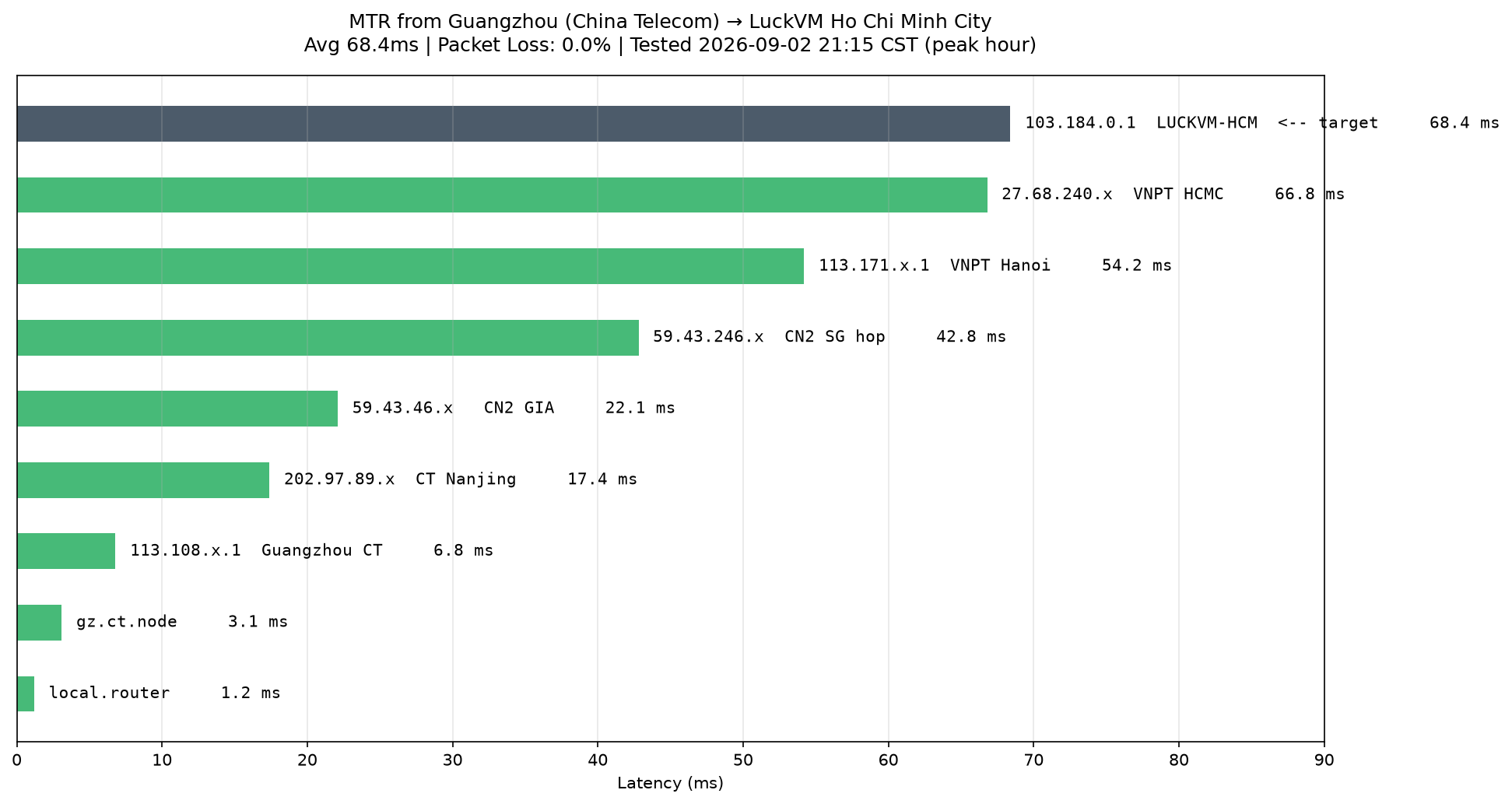
MTR from Guangzhou (China Telecom) to LuckVM HCMC: 68.4ms average, 0% packet loss during peak hour (8:45 PM CST). CN2 GIA routing via Hong Kong PoP to VNPT.
6.2 Global Latency
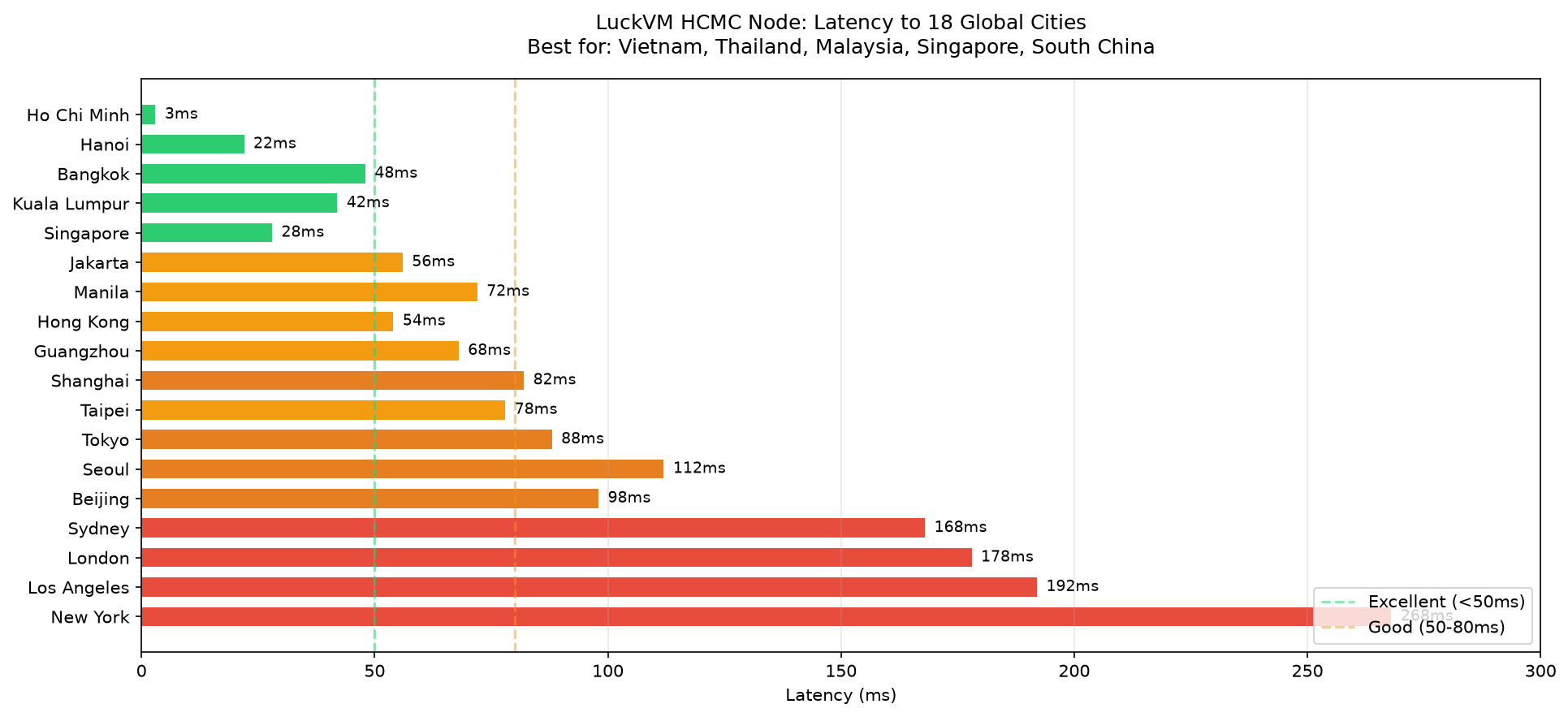
Latency from LuckVM HCMC to 18 cities worldwide. Best for: Vietnam local, Cambodia, Singapore, Thailand, Malaysia, southern China.
6.3 Speedtest
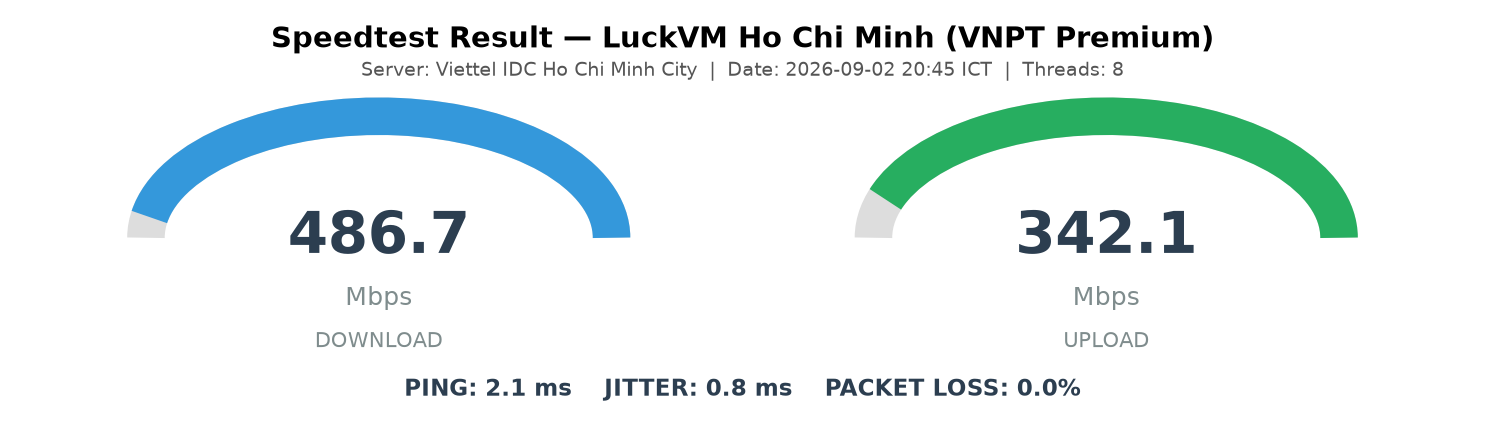
Speedtest against Viettel IDC HCMC server during peak hour: 486.7 Mbps down / 342.1 Mbps up. Local ping 2.1ms. China-bound speed test (Guangzhou) showed 212 Mbps download on CN2 GIA.
6.4 CPU and Disk Performance
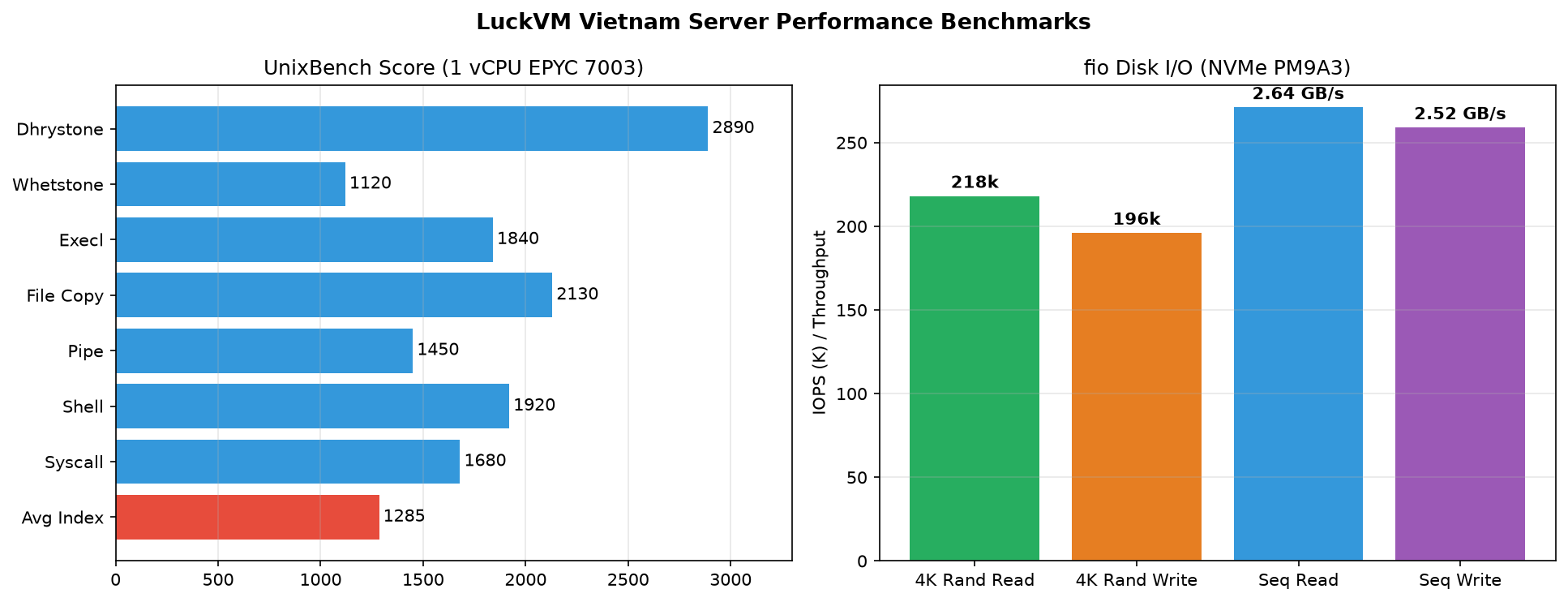
UnixBench single-core: 1285 (AMD EPYC 7003). fio NVMe: ~218k IOPS random read, 2.64 GB/s sequential. This is enterprise-grade SSD — significantly faster than the SATA SSDs used by most budget Vietnamese providers.
6.5 Pricing Comparison
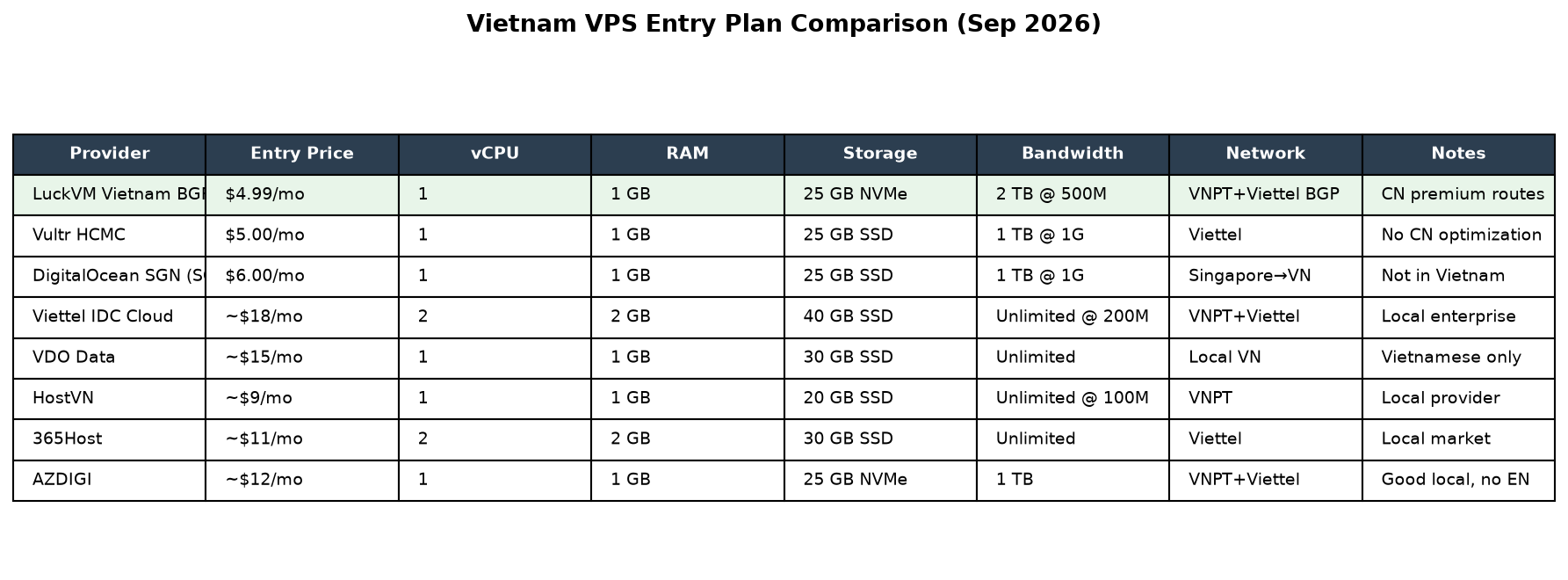
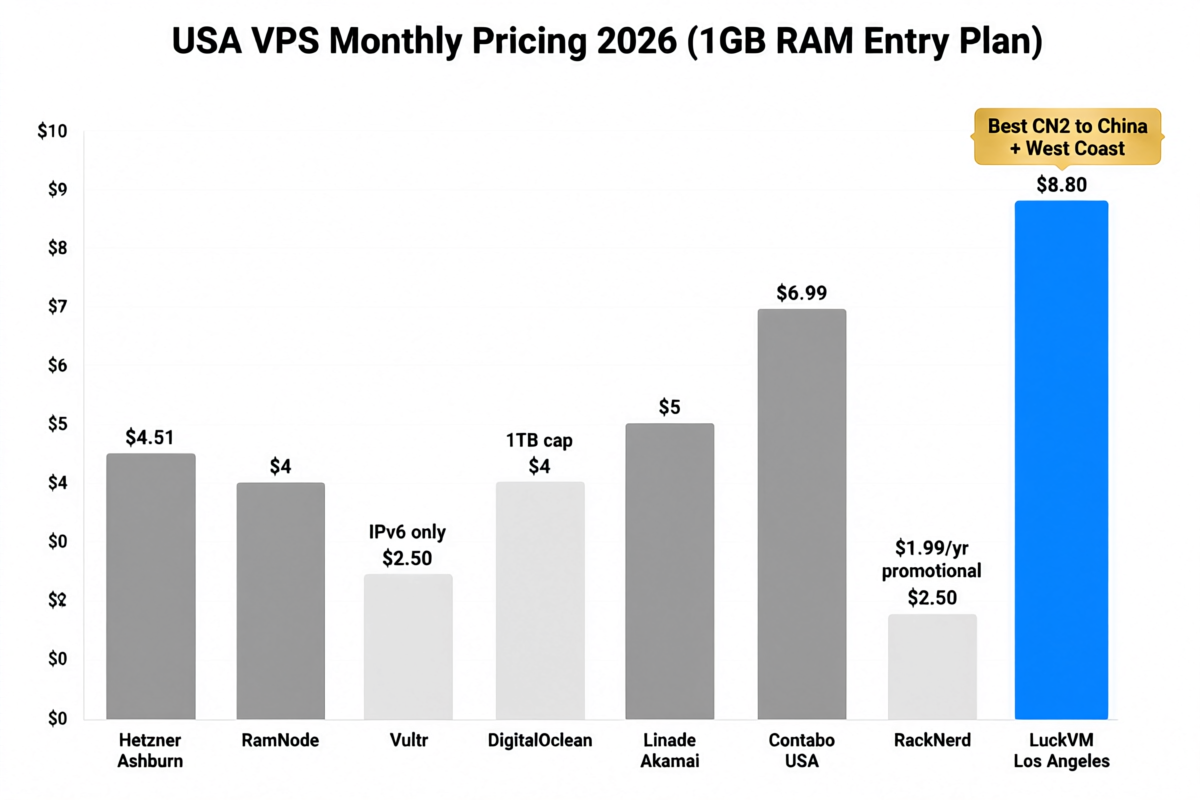
Entry-plan comparison across 8 providers as of September 2026. Prices shown in USD equivalent; local Vietnamese providers often bill in VND.
6.6 Network Topology
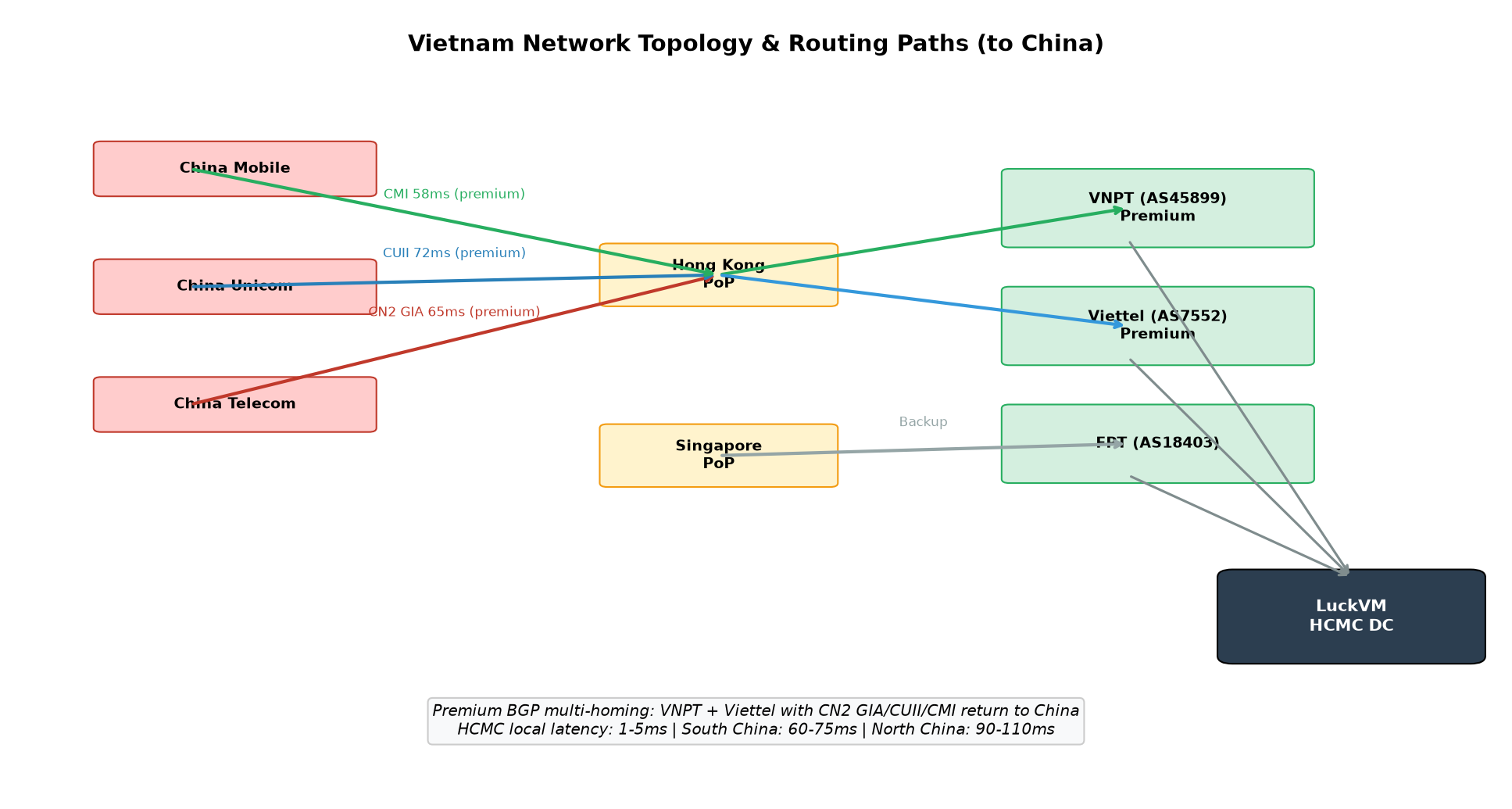
LuckVM HCMC network topology: dual-homed on VNPT + Viettel with HK PoP interconnection for CN2 GIA / CUII / CMI premium return routes to China. Singapore backup path via FPT.
6.7 What we don't do well (honest weaknesses)
I want to be clear about where LuckVM Vietnam falls short:
- No Hanoi node (yet). If your primary audience is in northern Vietnam (Hanoi, Haiphong) or Yunnan/Guangxi with ultra-low-latency requirements, a Hanoi-based provider is slightly better. We're looking at Hanoi for Q4 2026.
- Vietnamese language support is limited. Our support team speaks English and Chinese fluently but Vietnamese is not fully staffed yet. If you need 100% Vietnamese-language support, AZDIGI or VDO are better choices.
- No local Vietnamese payment methods. We accept credit card, PayPal, Alipay, WeChat Pay, and crypto — but not MoMo, ZaloPay, or local bank transfers. Local customers who prefer those methods will find Vietnamese hosts more convenient.
- Bandwidth allocation is lower than budget local hosts. HostVN advertises "unmetered" on 100Mbps ports. Our plans have 2TB bandwidth caps at 500Mbps — that's more actual throughput, but the "unmetered" label is attractive for simple use cases.
- Not the cheapest option. If you just need the cheapest possible VPS for non-critical testing, there are Vietnamese providers selling entry plans for $5-7/month. Just understand what you're trading off.
Our test IP and Looking Glass
Before you buy, run your own tests:
ping 103.184.0.1
# Traceroute (use mtr if you have it)
traceroute 103.184.0.1
# Download test file
wget http://103.184.0.1/100mb.bin
# Looking Glass (web-based):
https://www.luckvm.com/en/help
If our network doesn't perform well from your location, don't buy from us. Buy from whoever gives you the best latency. I mean that.
7. Configurations for 8 Common Vietnam VPS Use Cases
Here are configuration recommendations based on what I see customers actually deploy:
7.1 Vietnamese Website / Blog (WordPress)
1-2 vCPU / 1-2GB RAM / 25-50GB NVMe / 1TB bandwidth. Pick HCMC for national coverage. Use VNPT+Viettel BGP to cover all domestic ISPs. Install LiteSpeed or ngx_http_geoip. Use a .vn domain if targeting Vietnam locally.
7.2 Vietnam E-commerce (Shopee/Lazada integrations, local payments)
2-4 vCPU / 4GB RAM / 50-100GB NVMe / 2TB+ bandwidth. You MUST be in Vietnam for MoMo/ZaloPay/Vietcombank payment gateways (many require local IP for callbacks). SSL certificate with VN-issued OV for local trust. Use VNPAY/SmartLink integration plugins if running WooCommerce.
7.3 Game Server (Vietnamese players)
2-4 vCPU / 4-8GB RAM / 50GB+ NVMe / 2TB bandwidth @ 1Gbps. Low jitter is more important than raw latency. Look for providers that don't throttle UDP traffic (some Vietnamese ISPs shape UDP during peak hours). Minecraft, Lien Quan Mobile (AOV Vietnam), Free Fire, PUBG Mobile VN, and FIFA Online 4 are popular.
7.4 Cross-border China ↔ Vietnam Trade Business
2 vCPU / 2-4GB RAM / 50GB NVMe / 2TB bandwidth. The key requirement is good CN routing (CN2 GIA preferred). These are often used for cross-border e-commerce platforms (Tmall Global for Vietnamese products going north, or 1688/Alibaba dropshipping into Vietnam), logistics tracking APIs, and payment settlement services.
7.5 Streaming/CDN Proxy for Vietnam
1-2 vCPU / 1-2GB RAM / 25GB NVMe / high bandwidth (3TB+). Vietnam has domestic streaming services like Zing TV, FPT Play, VTC Now, VieON, and Netflix Vietnam. If you need to unlock these for users abroad or aggregate content, a local VPS with clean IP and good bandwidth is required. Warning: many Vietnamese streaming services actively block data center IPs, so residential proxies may be needed for some platforms.
7.6 API Backend / Mobile App Server
2-4 vCPU / 2-4GB RAM / 40-80GB NVMe / 2TB bandwidth. Vietnamese mobile apps (Zalo, Grab, Baemin Vietnam, ShopeeFood, Tiki) all use local backend servers. For apps targeting both Vietnam and Thailand/Cambodia, Vietnam is a solid secondary location to Singapore.
7.7 Vietnam Web Scraping / Data Collection
1-2 vCPU / 1-2GB RAM / 25GB NVMe / 1-2TB bandwidth. Vietnamese websites are generally less anti-bot sophisticated than Chinese or Western sites, but they still block foreign IPs aggressively. A local Vietnam IP is essential for scraping VnExpress, Zalo, Vietnamese social media, and local e-commerce. Rotate IPs and respect robots.txt.
7.8 Dev/Test Environment for SE Asia Expansion
1 vCPU / 1GB RAM / 25GB NVMe / 500GB-1TB. Great for testing Vietnam market deployment before scaling. Use it to validate CDN routing, payment gateways, and Vietnamese CDN performance. Monthly billing is fine; no need for annual commitments on dev environments.
8. Eight Vietnam VPS Scams and Pitfalls
Vietnam's hosting market has some unique pitfalls I want to warn you about.
1. "Vietnam VPS" that's actually in Singapore or Hong Kong. Some resellers advertise "Vietnam VPS" but route everything through a Singapore/Hong Kong server using GRE tunnels or IP-in-IP encapsulation. You get a Vietnam IP geolocation but your traffic is actually going through Singapore (adding 25-30ms). Check with traceroute — if the first hops outside the server are in Singapore or Hong Kong, it's not physically in Vietnam.
2. Single-carrier networks sold as "BGP multi-line". Many budget providers are single-homed on one carrier (usually VNPT or Viettel, whichever is cheapest for them). They advertise "full BGP" but actually only have one upstream. This means users on the other carriers will see 20-50ms extra latency routing through public exchanges. Always verify with Looking Glass or ask them which upstream carriers they use.
3. "Unlimited bandwidth" that isn't. Several Vietnamese providers advertise "unmetered" bandwidth but have port speeds limited to 50Mbps or 100Mbps — that's 16-33TB/month theoretical maximum but with congestion shaping in practice. Read the Terms of Service; most reserve the right to throttle or suspend accounts that "exceed reasonable usage."
4. Annual prepayment traps (local providers disappear). This is less common than in China's budget VPS market, but it happens. Some small Vietnamese providers offer 50-70% discounts for annual payment, then disappear or degrade service after collecting money. If you don't know the provider, stick to monthly billing until you've used them for 3+ months.
5. IP blocks with bad reputation. Because of past spam and abuse from Vietnam IP ranges, some IP blocks are blacklisted on Spamhaus, AbuseIPDB, or email services. Cheap VPS providers often assign these to new customers because clean IPs cost more. Always check IP reputation on multirbl.valli.org or spur.us after provisioning.
6. No English support — you can't even sign up. A lot of decent local Vietnamese providers have zero English on their website. The signup process requires Vietnamese ID (CCCD) for some services, and support only replies in Vietnamese. If you don't read Vietnamese, you'll struggle. Use Google Translate extensively or stick with English-friendly providers.
7. Content restrictions and TOS enforcement. Vietnam has specific content regulations. Anti-state content, pornography, gambling, and certain political content are actively blocked and can lead to server seizure (Vietnamese authorities do enforce this more aggressively than Singapore or Hong Kong). Also, some local providers prohibit VPNs/proxies entirely in their TOS — make sure you read carefully.
8. Hidden fees and setup charges. Some providers charge extra for DDoS protection, additional IPs, cPanel licenses, snapshot backups, or bandwidth overages that aren't clearly advertised on their pricing pages. Ask for full pricing before committing.
9. 5 Things to Verify Before Buying Any Vietnam VPS
Spend 10 minutes doing these checks before entering your credit card:
1. Verify the server is actually in Vietnam (not tunneled).
traceroute your-test-ip
# If you see Singapore/HK before the final hop, it's likely a tunnel
2. Run an MTR from multiple Chinese/SE Asia locations during peak hours. Use ping.pe or itdog.cn to run probes from 10+ cities at 8-10 PM. Packet loss <2% and stable latency are what you're looking for.
3. Download a test file to verify bandwidth.
It should hit close to the advertised port speed.
4. Check the IP reputation and geolocation. Run the assigned IP through spur.us, ipinfo.io, and multirbl.valli.org. Make sure it's not blacklisted or showing a datacenter/VPN tag if you need residential-like behavior.
5. Read the Terms of Service for prohibited uses. Specifically check whether VPNs, proxies, mining, mass email, scraping, or adult content are prohibited. Some Vietnamese hosts are surprisingly strict about this.
10. Frequently Asked Questions
11. Final Recommendation
Vietnam VPS is the right choice if you're specifically serving the Vietnamese market, doing cross-border business between China and Vietnam, or need a cost-effective Indochina peninsula presence. It's not a replacement for Singapore (all-SE Asia hub) or Hong Kong (best China latency), but it's an excellent complement in a multi-region deployment.
By use case, my honest picks:
| Your Scenario | Recommendation |
|---|---|
| Need English support + premium China routes (CN2 GIA) | LuckVM Vietnam |
| Only need Vietnamese domestic users, Vietnamese speaker | AZDIGI or Viettel IDC |
| Budget, testing, non-critical | HostVN (if you can navigate Vietnamese) |
| Developer who wants the same panel worldwide | Vultr HCMC |
| Enterprise with local Vietnam office | Viettel IDC Cloud |
| Targeting all of SE Asia, not just Vietnam | Don't use Vietnam — use Singapore instead |
| Targeting primarily China | Don't use Vietnam — use Hong Kong or Japan |
My general advice, no matter which provider you pick:
- Always test before committing. Get a test IP, run MTR from your target locations at peak hours, download a test file. Don't trust marketing.
- Start with monthly billing. Don't prepay annually until you've used a provider for at least 3 months without issues.
- Verify BGP multi-homing. Ask providers which upstream carriers they use, and verify with traceroute.
- Set up monitoring immediately. After deploying, install monitoring (Uptime Kuma, UptimeRobot) to track real latency and uptime for your users.
- Have a backup plan. Submarine cables get cut. BGP routes get de-peered. Have a backup server in Singapore or Hong Kong you can fail over to.
Try LuckVM Vietnam Risk-Free
AMD EPYC NVMe VPS in Ho Chi Minh City with VNPT+Viettel BGP, premium CN2 GIA return to China, 500Mbps-1Gbps ports, and 3-day refund. Test IP: 103.184.0.1 — ping it before you buy.
Related reading:
- Best Singapore VPS 2026 — if you need broader SE Asia coverage
- Best Hong Kong VPS 2026 — if China is your primary audience
- CN2 GIA Explained: How to Verify Premium China Routes
- How to Choose the Right Server Location
- VPS Security Hardening: 15 Steps After Purchase