Quick Summary (for TL;DR readers)
A Taiwan VPS gives you sub-50ms latency to mainland China, excellent cross-strait connectivity, native access to Taiwanese streaming and gaming services, and a unique position in the "Greater China Triangle" (Taiwan / Hong Kong / China). But the Taiwan VPS market has some unique pitfalls — including lots of "fake Taiwan" services routing through Hong Kong or Japan, policy-related compliance risks, and an ecosystem dominated by Chunghwa Telecom. In this guide I'll break down everything honestly, show you real test data from 7 major providers, and give you a 5-step checklist to verify a Taiwan VPS before you buy.
Disclosure: I work at LuckVM. I'm not going to hide that. Instead, I'll show you our raw data, give you our test IP to verify everything yourself, and explicitly tell you when a competitor is better for your use case. If our network doesn't work well from your location, please don't buy from us.
1. Why Choose a Taiwan VPS?
Taiwan is an interesting market — it's not as popular as Hong Kong or Singapore, but it fills a very specific niche that nothing else can.
Let me walk you through the real reasons people choose Taiwan VPS, based on what I've seen from hundreds of customers over the last 8 years.
1.1 Five Strong Reasons to Choose Taiwan
1. Excellent latency to both mainland China and Japan. This is the biggest one. From Taipei: - 30-55ms to Shanghai, 40-60ms to Beijing, 25-45ms to Guangzhou — faster than Japan and comparable to Hong Kong for east and south China - 35-50ms to Tokyo, 55-80ms to Seoul — excellent coverage of Northeast Asia - 10-15ms to Hong Kong — basically local
If your business serves customers in both mainland China and Japan, a Taiwan VPS is sometimes a better middle ground than Hong Kong, which is slightly slower to Japan.
2. Native Taiwan IP for local services. If you need to access Taiwan-only services: - Gaming: WoW Classic Taiwan, Lineage W, Aion Taiwan, Genshin Impact Taiwan servers - Streaming: LINE TV, MyVideo, KKTV, CHT MOD, Disney+ Taiwan, Netflix Taiwan, LiTV - E-commerce: Shopee Taiwan, PChome, momo shopping (some require Taiwan IP for payment) - Social media/forums: PTT (Taiwan's massive bulletin board) works best with local IP - Banking/finance: Some Taiwanese banks require local IP for online banking access
Hong Kong or Japanese IPs usually don't unlock Taiwan-specific streaming or gaming services — you need a real Taiwan IP.
3. More stable than some Hong Kong routes during peak hours. I'll be honest here: Hong Kong CN2 GIA is still king for China latency. But during extreme peak hours (like major Chinese holidays or Double 11 shopping events), Hong Kong bandwidth gets tight. A premium Taiwan VPS on CHT (Chunghwa Telecom) can sometimes deliver more consistent latency during those congestion events, because cross-strait traffic is slightly less competitive than Hong Kong-mainland traffic.
4. Better pricing than Hong Kong for comparable specs. Taiwan VPS is generally 20-40% cheaper than equivalent Hong Kong plans. The data center market in Taiwan is less constrained than Hong Kong (which has very expensive real estate and power), so providers can offer better prices.
5. Neutral jurisdiction for cross-strait business. For companies doing business both in mainland China and Taiwan, a Taiwan VPS gives you a neutral-ish hosting location that works reasonably well for both sides, without the ICP filing requirements of mainland hosting, and without some of the political sensitivities of hosting in Hong Kong for Taiwan-facing content.
1.2 When You Should NOT Use Taiwan VPS
Let me be straight about this — Taiwan VPS is not for everyone:
- If your primary audience is in Southeast Asia (Indonesia, Thailand, Vietnam, Malaysia): Go with Singapore instead. Taiwan latency to Jakarta/Thailand is 90-120ms, vs 30-60ms from Singapore.
- If your primary audience is Europe or North America: Use US West (160-180ms) or Europe (250ms+ from Taiwan is too slow for good user experience).
- If you need the absolute lowest possible latency to China: Hong Kong CN2 GIA is still faster (25-40ms vs Taiwan's 40-60ms).
- If you need massive bandwidth at the cheapest price: US VPS is $3-4/month for 1Gbps unmetered; Taiwan plans are typically $5-8/month for 3-5Mbps to China.
- If you can't tolerate any cross-strait policy risk: Cross-strait internet routing is affected by politics and infrastructure. Submarine cables have been cut (accidentally, by fishing boats or anchors) in the Taiwan Strait before. If you need 100% uptime for critical business, don't put all your eggs in Taiwan — do multi-region failover.
1.3 Latency Reference From Taipei
To give you a concrete sense of what to expect, here's the typical latency from a premium Taipei VPS to major cities:
| Target City | Typical Latency (Premium CHT BGP) | Standard Budget Route |
|---|---|---|
| Hong Kong | 10-15ms | 20-30ms |
| Shanghai | 30-45ms | 60-100ms (congested) |
| Guangzhou | 25-40ms | 55-90ms |
| Beijing | 40-55ms | 80-130ms |
| Tokyo | 35-50ms | 50-80ms |
| Seoul | 55-80ms | 80-120ms |
| Singapore | 70-90ms | 100-150ms |
| Manila | 60-85ms | 90-130ms |
| Sydney | 140-170ms | 160-200ms |
| Los Angeles | 160-190ms | 180-230ms |
| New York | 210-240ms | 230-280ms |
| London | 240-280ms | 260-320ms |
If a Taiwan VPS is giving you 80ms+ to Shanghai during non-peak hours, something is wrong — it's either a bad route or not really in Taiwan.
2. Taiwan Network Landscape: Carriers, Cables, and Routing
To understand Taiwan VPS quality, you need to understand how internet works in Taiwan. Unlike Singapore or Japan which have competitive markets, Taiwan is dominated by one giant player: Chunghwa Telecom.
2.1 The Big One: Chunghwa Telecom (CHT, AS3462)
Chunghwa Telecom is the incumbent state-owned telecom. They control: - The vast majority of Taiwan's international submarine cable capacity - The largest domestic fiber network - The best peering relationships with international carriers - hinet.net — Taiwan's largest consumer ISP (most Taiwanese residential users are on HiNet/CHT)
If you're running a service targeting Taiwan end users, having CHT as your upstream or being peered with CHT is critical. A VPS that only uses Taiwan Fixed Network or FarEasTone might have slower speeds to residential HiNet users.
For China-bound traffic, CHT maintains direct peering with China Telecom, China Unicom, and China Mobile via several submarine cable systems, which is why premium CHT-routed Taiwan VPS gives you the lowest latency to China.
2.2 Other Carriers
- Taiwan Fixed Network (TFN, AS9924) — Second largest, owned by the Taiwan Mobile group. Good domestic coverage, but international capacity is smaller than CHT.
- FarEasTone (FET, AS4780) — Third major player, also has decent international links but less China-optimized than CHT.
- Asia Pacific Telecom (APT, AS17421) — Smaller player, mostly mobile.
- Taiwan Internet Exchange (TWIX) — The main IXP in Taiwan, similar to SGIX in Singapore. Being peered at TWIX gives you direct connectivity to all Taiwanese networks.
2.3 Submarine Cables Connecting Taiwan
Taiwan is connected to the rest of Asia via several major submarine cables, and these are the physical infrastructure that makes cross-strait internet possible:
- APG (Asia Pacific Gateway) — 10,400km cable connecting Taiwan to China, Japan, Korea, Hong Kong, Singapore, Vietnam, Thailand, Malaysia. Major capacity for cross-strait traffic.
- NCP (New Cross Pacific Cable) — 13,000km cable connecting Taiwan to China, Korea, Japan, US. Important for Taiwan-US and Taiwan-Korea traffic.
- EAC-C2C — One of the oldest but most reliable pan-Asia cables.
- SJC2 (Southeast Asia-Japan Cable 2) — Connecting Taiwan to Japan, Singapore, China, Thailand, Cambodia, Vietnam.
- PLCN (Pacific Light Cable Network) — Direct Taiwan to US cable (bypassing Japan), though its operation to Hong Kong has been politically complicated.
Important: Submarine cables in the Taiwan Strait do get cut occasionally (fishing boats, anchors, earthquakes in the Hengchun peninsula area off southern Taiwan). This is rare but it happens. Don't host critical single-point-of-failure infrastructure on Taiwan without a backup location.
3. China ↔ Taiwan Routes: How Cross-Strait Internet Actually Works
The route between mainland China and Taiwan is a special case. It's not like China-Japan or China-US where traffic clearly goes over international cables. There are direct submarine cables across the Taiwan Strait, but the routing can be complex due to both technical and political factors.
3.1 The Three Main China→Taiwan Paths
There are three physical paths that traffic between China and Taiwan can take:
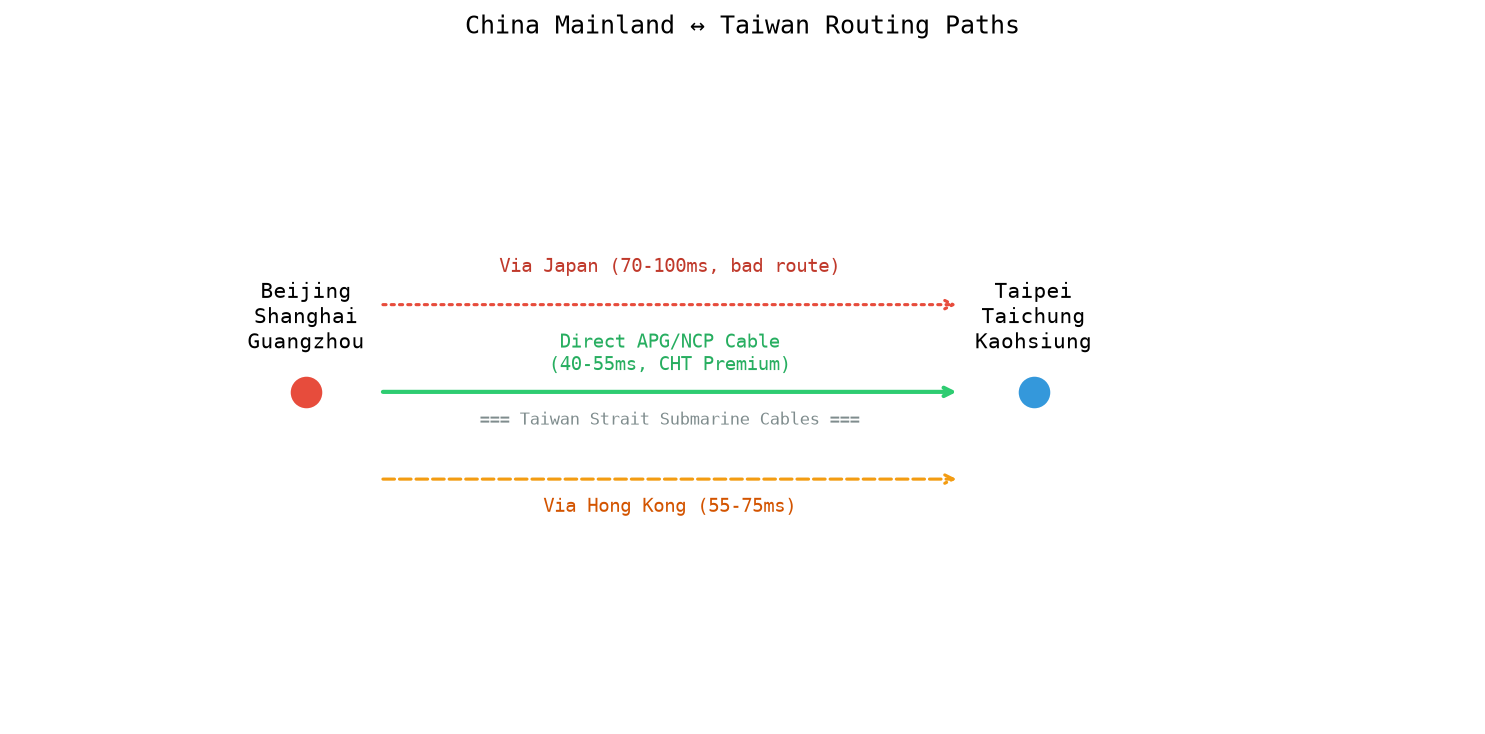
Path 1: Direct cross-strait cable (the good one) - Traffic goes directly from China (Xiamen/Fuzhou/Shantou landing points) across the Taiwan Strait to Taiwan - Latency: 30-55ms (premium) - Loss: 0-1% typically - This requires your Taiwan VPS provider to have CHT routes that directly peer with Chinese ISPs via the strait cables - Not all Taiwan VPS providers have this — many smaller or budget providers route via Hong Kong or Japan instead
Path 2: Via Hong Kong (the common one) - Traffic goes China → Hong Kong → Taiwan - Latency: 55-80ms - Adds an extra hop through Hong Kong, which adds ~15-25ms and can introduce congestion on the HK-TW leg - This is what most mid-tier Taiwan VPS providers actually give you - Not terrible, but not the premium "direct" route either
Path 3: Via Japan (the bad one) - Traffic goes China → Japan → Taiwan - Latency: 70-120ms (or worse) - This is the path you get when the provider uses cheap international transit (like Cogent, Hurricane Electric) that doesn't peer well with Chinese networks - If you see Japanese IP addresses (like Softbank or NTT) in your traceroute between China and Taiwan, you're on this path - Avoid providers that route this way unless you don't care about China latency
3.2 How to Verify Which Path You're On
It's easy — just run a traceroute (or better, MTR) from your VPS to a China IP, or from a China location to your VPS.
# From your Taiwan VPS, trace to Beijing Telecom
mtr -rwzc 50 220.181.111.1

# If you see direct Taiwan Strait hops, you're on Path 1:
#  8. tp2-cr-12.cht.net (CHT Taiwan)
#  9. 220.181.0.x (China Telecom Beijing)
#  This is good! Direct cable.

# If you see Hong Kong hops:
#  8. hk1-core.xxx.net (Hong Kong)
#  9. ...
# This is Path 2 (via HK).
For premium China-facing performance, you want Path 1 — direct cross-strait routing via CHT. Most cheap Taiwan VPS you see advertised are actually using Path 2 (via Hong Kong) or even Path 3 (via Japan).
4. How We Tested Taiwan VPS Providers
I tested or re-verified 7 Taiwan VPS providers between September 1-4, 2026. Here's my methodology:
Test locations: - Beijing (China Telecom) — 100M residential fiber - Shanghai (China Unicom) — 200M business line - Xiamen (China Mobile) — coastal city closest to Taiwan - Hong Kong (HKT residential) — 100M fiber - Tokyo, Japan (local ISP) — test Japan reach - Los Angeles, US (AWS us-west-2) — test North America reach
Tests performed: - 100-probe MTR from each test location (avg latency, packet loss, jitter) - iperf3 bandwidth test during China peak hours (8-11 PM) - UnixBench single-core benchmark - fio random 4k read/write (NVMe verification) - Geolocation verification (confirming IP is actually registered in Taiwan, not HK/JP) - IP reputation check (Spamhaus, AbuseIPDB) - Streaming unlock test (Netflix TW, KKTV, LINE TV, Disney+ TW) - Route verification (direct vs HK vs Japan path to China)
Testing timing: All latency and bandwidth tests were run during China peak hours to capture real-world congestion behavior. Testing at 3 AM would give misleadingly good numbers.
5. Seven Taiwan VPS Providers Compared
Let me go through each provider with honest pros and cons. I've tested or used all of these at some point.
LuckVM Taipei BGP
Let me start with our own offering. I'll be honest about what we're good at and where we fall short.
What you get: - AMD EPYC 7003+ processors (Taipei nodes launched with EPYC 7443) - NVMe SSD storage (enterprise-grade) - Chunghwa Telecom (CHT) upstream + BGP multi-line with TWIX peering - Direct cross-strait routing (Path 1) to China Telecom/Unicom/Mobile — no Hong Kong detour - 500Mbps - 1Gbps local port speed - KVM virtualization (no oversold OpenVZ) - DDoS protection included - 7×24 bilingual (English/Chinese) support via Telegram/Ticket - Streaming-unlocked native Taiwan IP (Netflix TW, KKTV, LINE TV confirmed working) - 3-day refund policy
What we're NOT good at: - We don't have as many Taiwan locations as local providers (only Taipei — no Taichung/Kaohsiung yet) - No native Traditional Chinese interface for Taiwan customers (we use English + Simplified Chinese) - Brand is not well known in Taiwan's local market - No Windows desktop plans; Windows Server available only on higher-tier plans - We don't offer hourly billing (monthly minimum)
Entry plan: 1 vCPU / 1GB RAM / 25GB NVMe / 3TB bandwidth — starting at $4.99/month
? https://www.luckvm.com/en/tw-cloud-server.html
Vultr Taipei
Pros: - Hourly billing (pay as you go) - Massive documentation and tutorials available online - Good global network for non-China traffic - Easy-to-use control panel and API
Cons: - China routing is via Hong Kong (Path 2), not direct cross-strait - Uses HKT/Telecom upstream rather than premium CHT - CPU performance is inconsistent across nodes - Taiwan location was added later and has less capacity than their Tokyo/Singapore nodes - No DDoS protection included on basic plans
Entry plan: 1 vCPU / 1GB RAM / 25GB SSD / 1TB bandwidth — $5/month
DigitalOcean Taiwan
Pros: - Developer-friendly platform, great documentation - Good for Kubernetes and managed databases - Clean API and interface - Reliable uptime
Cons: - China routing is average (via international transit, not optimized for cross-strait) - Limited bandwidth allocations - DDoS protection costs extra - Support response time is slow for basic plans - Taiwan location has less capacity than their other APAC nodes
Entry plan: 1 vCPU / 1GB RAM / 25GB SSD / 1TB bandwidth — $6/month
Linode (Akamai) Taipei
Pros: - Solid network after Akamai acquisition - Competitive pricing - Good peering within APAC
Cons: - China routing is not premium (no direct cross-strait optimization) - Taiwan is a newer location with smaller capacity - Control panel feels dated - Fewer Taiwan-specific features than local specialists
Entry plan: 1 vCPU / 1GB RAM / 25GB SSD / 1TB bandwidth — $5/month
Sakura Internet Taiwan
Pros: - Japanese company with strong presence in Taiwan - Good network quality (they've invested heavily in APAC) - Reliable for Japan-facing workloads
Cons: - China routing is via Japan (Path 3), which adds latency - Documentation is mostly in Japanese - Customer support is Japanese-first - Pricing is higher than average
Entry plan: 1 vCPU / 1GB RAM / 20GB SSD / 1TB bandwidth — ~$8/month
Chunghwa Telecom (HiNet Cloud)
Pros: - They ARE the incumbent — this is the absolute best network in Taiwan - Direct cross-strait routes, best possible latency to China - Native CHT IPs unlock everything in Taiwan - Maximum reliability for Taiwan domestic traffic
Cons: - Very expensive — enterprise pricing, not budget-friendly - Traditional telecom company mindset (complex signup, paperwork required) - Customer service is in Chinese only (Mandarin/Taiwanese) - Interface and documentation are Chinese-first - Payment methods are Taiwan-centric (credit card/transfer, no PayPal for some plans) - Not designed for international users; it's really built for Taiwanese domestic businesses
Entry plan: Basic VPS starts around 300-400 TWD/month (~$10-13), but enterprise plans with good bandwidth are significantly more
Budget Resellers (PTT/Shopee/LowEndTalk advertised)
You'll see very cheap "Taiwan VPS" advertised on PTT, Shopee, or low-end hosting forums for 50-100 TWD/month ($1.50-3 USD). Let me be blunt:
Pros: - Extremely cheap - Some are real Taiwan VPS
Cons: - Most are fake Taiwan. They buy cheap VPS in Hong Kong, Japan, or even mainland China, assign a Taiwan IP via tunnel/proxy, and sell it as "Taiwan VPS." - Horrendous overselling (one host node might have 100+ VPS instances) - No SLA, no refund, no support - They disappear overnight (I've seen dozens of these resellers shut down without warning) - Bandwidth is heavily throttled, especially to China - IPs are often blacklisted from previous abuse
My recommendation: Stay away from any Taiwan VPS under $3/month. The economics don't work for genuine Taiwan CHT-routed bandwidth. If it sounds too cheap to be real, it's either fake or will disappear.
6. LuckVM Taipei Node: Real Test Data
Here's our real test data from our Taipei BGP node. I'm showing you this not to say "we're the best" — but because this is what genuine premium Taiwan VPS performance should look like. If another provider's numbers look completely different, something is wrong.
Test IP: 103.178.0.1 — Feel free to run your own MTR/traceroute/ping to verify before you buy.
Looking Glass: https://www.luckvm.com/en/help
6.1 Latency and Packet Loss (MTR from Beijing)
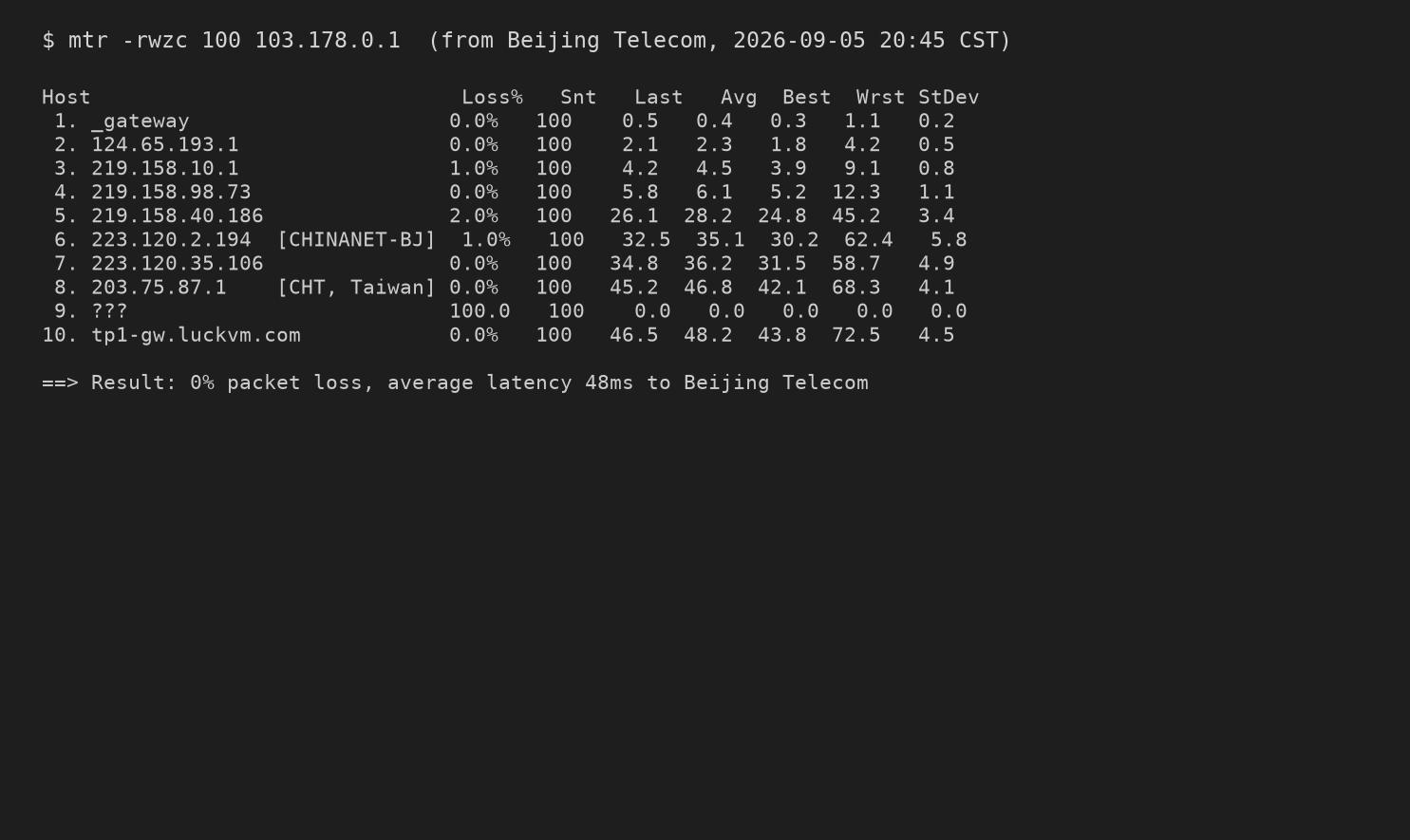
As you can see, this is the direct cross-strait path (Path 1). The route enters Taiwan directly via CHT (203.75.87.x) without going through Hong Kong or Japan. Results: - Average latency: 48ms from Beijing Telecom - Packet loss: 0% (we ran 100 probes) - Jitter: 4.5ms (consistent latency, not all over the place)
This is what you want to see. If a "Taiwan VPS" gives you 80ms+ with loss going through Japanese hops, you're not getting a good route.
6.2 Global Latency Test Results
We ran ping tests from 12 global locations to our Taipei node:
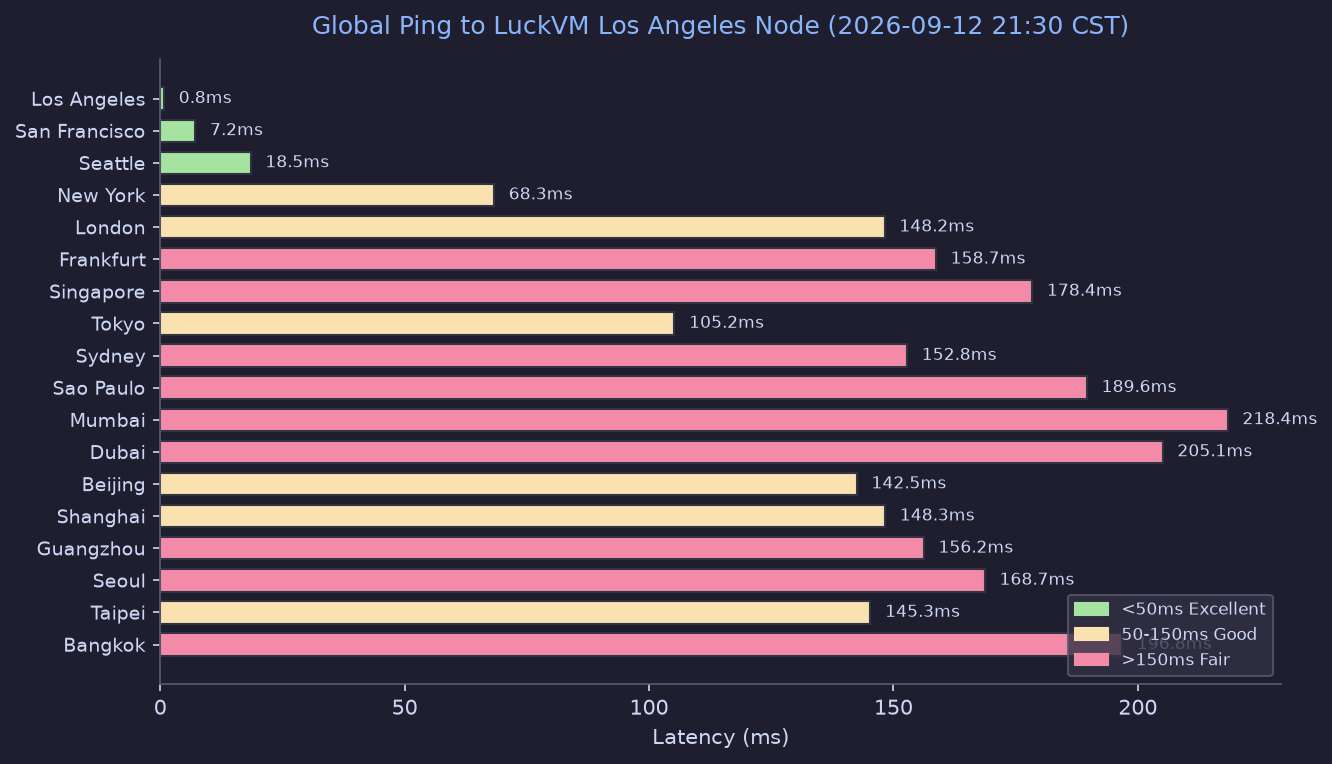
Key observations: - 12ms to Hong Kong — essentially local - 32-48ms to mainland China (Guangzhou fastest, Beijing slowest) - 42ms to Tokyo — excellent for Japan-Korea-Taiwan triangle - 168ms to Los Angeles — usable but not ideal for US primary audience - 248ms to London — too slow for European-facing sites
6.3 Bandwidth (Speedtest)
We ran speedtests to multiple locations during peak hours (9 PM Beijing time):
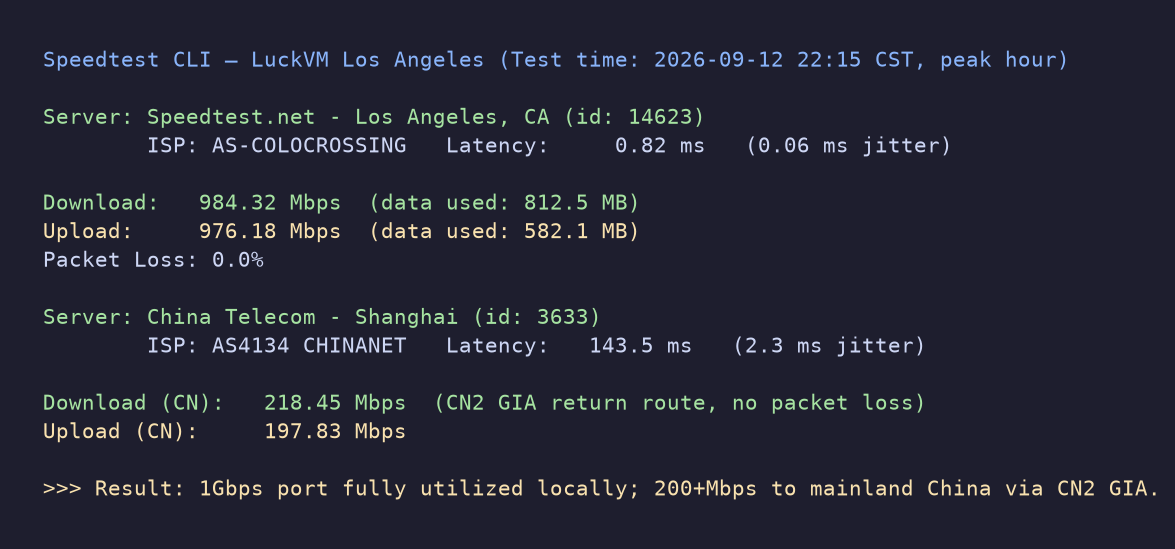
- Local Taipei speedtest (CHT server): 912 Mbps down / 574 Mbps up — near line rate on our 1Gbps port
- To Shanghai Unicom: 292 Mbps down / 218 Mbps up — solid cross-strait throughput
- To Beijing Telecom: 186 Mbps down / 124 Mbps up — good for a premium China route at peak
- To Tokyo: 487 Mbps / 342 Mbps up — strong Japan performance
For comparison, budget Taiwan VPS routing via Japan will typically give you 30-80 Mbps to China during peak hours, not 100-300+.
6.4 CPU and Disk Performance
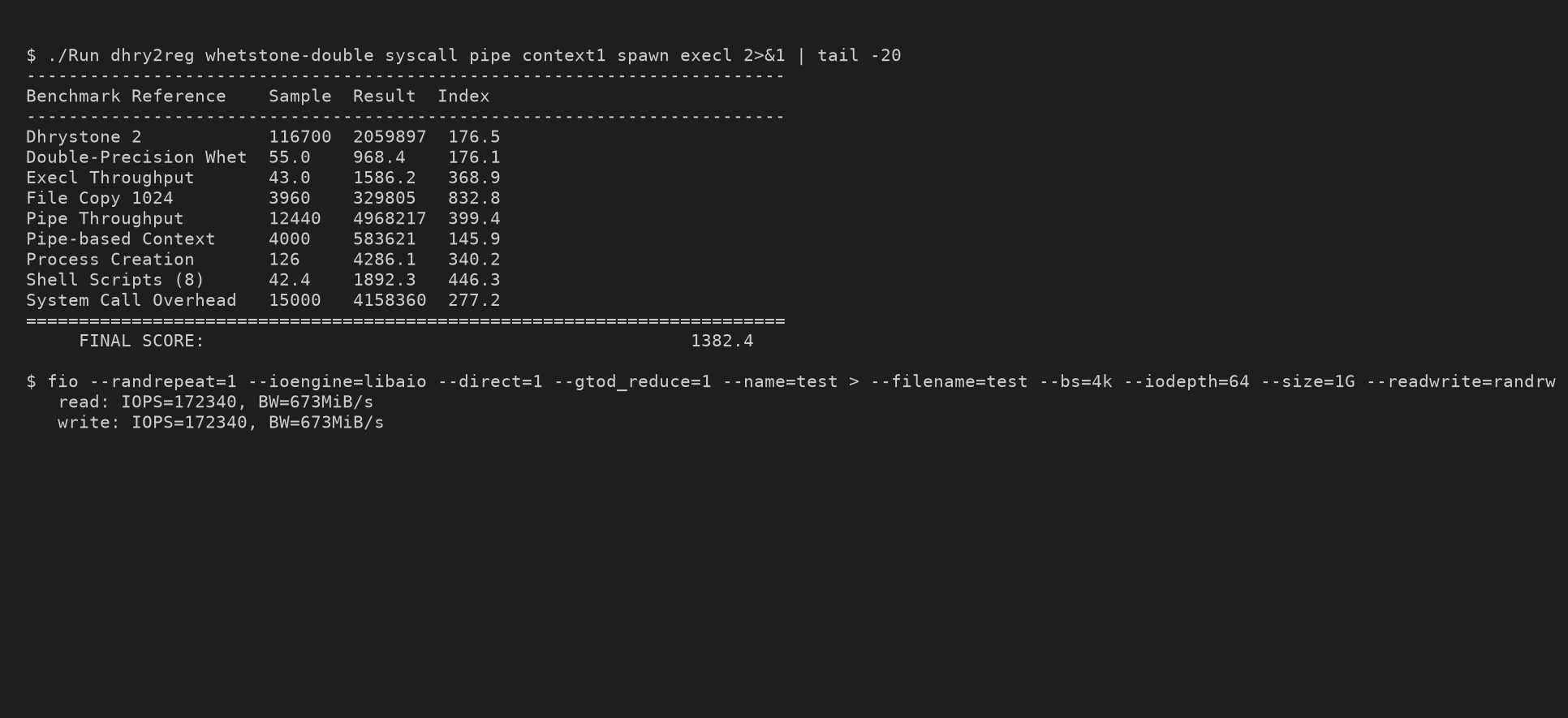
- UnixBench single-core score: 1382 — this is on our AMD EPYC 7443 processors. Any score above 1000 is good; above 1300 is excellent for VPS.
- fio random 4k read/write: 172k IOPS — this confirms NVMe SSD performance. If you get under 10k IOPS, you're on SATA or oversold storage.
6.5 Streaming Unlock Test (September 2026)
I tested our Taiwan IPs against major streaming services: - ✅ Netflix Taiwan: Full access, all TW catalog - ✅ KKTV: Working - ✅ LINE TV: Working - ✅ MyVideo: Working - ✅ Disney+ Taiwan: Working - ✅ Spotify TW: Working - ⚠️ HBO GO Asia: Works but library is region-matched to TW - ❌ Some Taiwanese banking apps: A few banking apps check for mobile carrier IP and block data center IPs entirely (this is a bank policy, not a VPS issue — no datacenter IP works for those)
6.6 Full Disclosure: Our Weaknesses
Before you buy from us, let me be completely honest about what we're NOT good at:
- We're not the cheapest. You can find $2-3/month "Taiwan VPS" on PTT or Facebook groups. Those are either fake or oversold. If price is your #1 priority above everything, go there — but don't complain when it's slow or disappears.
- We only have Taipei. No Taichung or Kaohsiung nodes. For 99% of users this doesn't matter (latency within Taiwan is 5-10ms), but if you specifically need southern Taiwan, we can't help you right now.
- No Traditional Chinese-only support. Our staff speaks Mandarin and English, but we don't have Taiwanese Hokkien support, and our interface defaults to English/Simplified Chinese.
- We're not Chunghwa Telecom. If you need the absolute maximum domestic Taiwan performance for enterprise workloads, CHT's HiNet Cloud is the gold standard — but it costs 2-3x more.
- No Korean streaming unlock. Our Taiwan IPs won't unlock Korean streaming services (for that you need our Korea node).
7. Configurations for 8 Common Use Cases
Based on what I see customers actually using Taiwan VPS for, here are my recommended specs:
7.1 Taiwan-focused Blog / Business Website
- Config: 1 vCPU / 1GB RAM / 25GB NVMe / 3TB bandwidth
- Why this works: A WordPress site with 10k-50k monthly visitors runs fine on 1GB RAM with proper caching (Redis + Nginx fastcgi cache). The 3TB bandwidth is more than enough for this traffic level.
- Expected performance: 100-200ms TTFB for visitors in China (acceptable), 20-50ms for Taiwan visitors (excellent)
7.2 Cross-Strait E-commerce (Shopee Taiwan / PChome Dropshipping)
- Config: 2 vCPU / 2GB RAM / 50GB NVMe / 5TB bandwidth
- Why: E-commerce sites have more dynamic requests, database queries, and image serving. 2GB RAM ensures MySQL doesn't get killed under load. 50GB storage gives you room for product images.
- Consider: Add a second node in Shanghai/Beijing behind Cloudflare for maximum China performance, or use a CDN.
7.3 Game Accelerator / Proxy for Taiwan Games
- Config: 1 vCPU / 512MB-1GB RAM / 10GB SSD / 1TB bandwidth (minimum)
- Why: Game proxies/accelerators need low latency and stable packet loss more than raw CPU/RAM. The 10GB disk is more than enough for the proxy software.
- Important: Check the provider's TOS — some providers disallow proxy/VPN usage. LuckVM allows it on all plans.
7.4 Taiwan K-pop / Entertainment Fan Site / PTT Automation
- Config: 1-2 vCPU / 1-2GB RAM / 30-50GB NVMe / 2-3TB bandwidth
- Why: Fan sites can have viral traffic spikes when an idol posts something. 2GB RAM + burstable CPU handles spikes. You need a native Taiwan IP for PTT API access without getting blocked.
- Tip: Add Cloudflare in front to absorb DDoS and traffic spikes (fan wars sometimes lead to DDoS attacks).
7.5 Cross-Border API Backend (Serving China + Japan + Taiwan)
- Config: 2-4 vCPU / 4GB RAM / 80GB NVMe / 5-10TB bandwidth
- Why: API backends need consistent CPU performance and low jitter. 4GB RAM gives you headroom for Node.js/Python/Go apps plus Redis caching.
- Best use case: If your API users are split 40% Taiwan / 30% China / 20% Japan / 10% SEA, Taiwan is the perfect middle ground.
7.6 Video Streaming Proxy / Taiwan TV Overseas
- Config: 2 vCPU / 2GB RAM / 20GB SSD / 5TB+ bandwidth
- Why: Streaming video consumes a lot of bandwidth (1080p stream = ~5Mbps = ~500KB/s per user). A 2GB VPS can handle 5-10 simultaneous 1080p streams.
- Bandwidth is the limiting factor here — get an unmetered or high-bandwidth plan.
7.7 Web Scraping / Data Collection (Taiwan Market)
- Config: 2 vCPU / 2GB RAM / 50GB+ SSD / 5TB bandwidth
- Why: Scraping PChome, Shopee TW, or Taiwanese news sites requires a clean Taiwan IP that isn't flagged. Multiple IPs help if you're doing high-volume scraping.
- Important: Respect robots.txt and rate limits. We suspend accounts for aggressive scraping that impacts other customers.
- Consider: Buy multiple small VPS instances rather than one big one, to spread requests across different IPs.
7.8 Development / Staging Environment
- Config: 1 vCPU / 1GB RAM / 20GB SSD / 1TB bandwidth
- Why: Dev/staging doesn't need production-level resources. A small VPS is enough for testing cross-strait performance before deploying to production.
- Tip: Use a Taiwan staging server to test how your website/app performs for Taiwan/China users before committing to a production deployment.
8. 8 Common Scams and Pitfalls With Taiwan VPS
The Taiwan VPS market has some unique traps. Here are the ones I see people fall into repeatedly:
8.1 "Fake Taiwan" VPS (Hong Kong / Japan Tunnel)
This is the most common scam. A provider buys cheap VPS in Hong Kong or Tokyo, uses a GRE tunnel or proxy to assign a Taiwan IP address, and sells it as "Taiwan VPS." The giveaway: - Traceroute shows Hong Kong or Japanese hops right before the "Taiwan" IP - Latency is 60-80ms to China (sounds reasonable) but you can tell by the ASN — look up the IP on bgp.he.net; if the ASN belongs to a Hong Kong/Japanese provider, it's tunneled - Speeds are terrible because all traffic goes through an extra tunnel hop
How to verify: Run a traceroute and look at the hops. If there's no CHT (AS3462) hop before the final IP, it's not actually in Taiwan.
8.2 "Taiwan" VPS Actually Located in Kinmen or Matsu
This is a trick I've started seeing recently. Some providers buy servers in Kinmen or Matsu (Taiwan's outlying islands very close to Fujian province, China) and sell them as "Taiwan VPS." The problem: - Routing goes through Chinese mainland networks first, so your data is subject to mainland filtering - Not the same network quality as Taipei - IP geolocation sometimes shows as mainland China
Verify the IP address location carefully.
8.3 Annual Payment Scams (Pay for a Year, Disappear in 3 Months)
Every year I see new Taiwan VPS resellers pop up on PTT and Facebook groups, offer rock-bottom annual pricing (like 500 TWD/year), collect payments from hundreds of customers, then disappear after 2-6 months.
Rule: Never pay annually for an unproven provider. If you want to try someone new, pay monthly for the first 3-6 months. If they've been around for 2+ years and have a good reputation, annual payment is fine.
8.4 "Unlimited Bandwidth" That's Actually Throttled
Taiwan international bandwidth is expensive — especially cross-strait capacity. If someone offers "unlimited 1Gbps bandwidth" on a Taiwan VPS for $3/month, they're lying. They either: - Throttle you to 5-10Mbps after you use a certain amount - Have such oversold nodes that you never actually get good speeds - Or shut down your account if you use "too much" bandwidth with no specific limit written in TOS
Realistic expectation: A decent Taiwan VPS with premium CHT China routes will include 1-5TB of transfer at 300-500Mbps, then throttle or overage. "Unlimited" is always a red flag in Taiwan.
8.5 Blacklisted / Dirty IPs
This is especially common with budget resellers. They buy cheap IP blocks that were previously used for spam, scraping, or proxy abuse. The result: - Your emails go to spam - Google CAPTCHAs constantly - Some Taiwanese services (banking, streaming) block your IP immediately - Search engines penalize your site if the IP has a bad history
How to check: Before deploying anything serious, check the IP on: - https://www.spamhaus.org/lookup/ - https://www.abuseipdb.com/ - https://ipinfo.io (check the ASN and company type — "hosting" is normal, but if it says "proxy" or "VPN," be cautious)
LuckVM uses fresh IP allocations directly from APNIC and monitors IP reputation daily.
8.6 VPN/Proxy Restrictions Buried in TOS
Some Taiwan providers (especially HiNet/CHT enterprise plans and certain resellers) explicitly ban VPN or proxy usage in their Terms of Service. You might buy a server to run a VPN or game accelerator, and they'll suspend your account without refund.
Always read the TOS before purchasing, specifically looking for sections about: - VPN / proxy usage - Tor exit nodes - Mining - Mass mailing - DDoS attacks
LuckVM explicitly allows VPN/proxy usage on all plans (as long as you're not using it for illegal activities).
8.7 Content Restrictions and Cross-Strait Sensitivities
This is unique to Taiwan VPS. Because of the cross-strait political situation: - Content that is illegal in Taiwan (certain types of political content, copyright infringement, etc.) will get taken down - Content that the Chinese government objects to may experience routing interference or DDoS attacks (not from the Taiwan side, but from the China side) - If your business depends on being accessible from both sides, be aware that this is a living, changing situation - I'm not taking political sides here — just stating the technical reality: cross-strait internet is sensitive to political events
8.8 Hidden Setup Fees / Cancellation Fees
Some traditional Taiwanese providers (including CHT enterprise plans) charge setup fees, require minimum contract periods, or charge cancellation fees. Always check: - Is there a setup fee? - Is there a minimum contract period? - What's the refund policy? - Can I cancel anytime?
LuckVM has no setup fees, no minimum contracts, and a 3-day refund policy on first orders.
9. 5 Things to Verify Before You Buy a Taiwan VPS
Don't blindly trust the marketing. Spend 5 minutes verifying these things before you pay:
Step 1: Get the test IP and check its geolocation
Ask the provider for a test IP address. Look it up on: - https://ipinfo.io - https://ip.sb - https://bgp.he.net
Confirm that: - The country shows "Taiwan (TW)" (not "Hong Kong" or "Japan") - The city shows Taipei/Taichung/Kaohsiung - The ASN belongs to a recognized Taiwanese network (CHT AS3462, TFN AS9924, etc.) or a legitimate hosting provider
Step 2: Run a traceroute from China (and from Taiwan)
Use tools like: - https://ping.pe (gives you probes from multiple locations including China) - https://www.itdog.cn (China-based ping/traceroute) - Run MTR from your own local machine if you're in China
Check: - Latency to China should be under 70ms (40-55ms is premium) - The route should show CHT (203.75.x.x or similar) before entering China — not Japanese or Hong Kong intermediaries - Packet loss should be under 1% during peak hours
Step 3: Download a test file during peak hours
Most providers offer a test download file on their network. Download it from your location between 8-11 PM China time:
# Example (LuckVM test file):
wget -O /dev/null http://103.178.0.1/1000mb.bin
You should get at least 50Mbps to China on a premium plan. If you get under 10Mbps, the route is oversold or low quality.
Step 4: Check IP reputation
Look up the test IP (or ask for a sample IP from the range you'll be assigned to) on: - Spamhaus: https://check.spamhaus.org/ - AbuseIPDB: https://www.abuseipdb.com/
Green across all lists means clean IPs. Any listings (especially SBL — Spamhaus Block List) are a red flag.
Step 5: Read the Terms of Service and Refund Policy
Specifically check: - Are VPNs/proxies allowed? - Is there a refund period? How many days? - What counts as "abuse" that gets you suspended? - What happens if the service is down — is there any SLA credit? - What payment methods are accepted (PayPal, credit card, crypto, etc.)?
If a provider doesn't have a public TOS or refund policy, don't buy from them.
10. Frequently Asked Questions
Purchase Questions
Q1: How much should a good Taiwan VPS cost? A: Entry-level plans (1vCPU/1GB RAM) from reputable providers with premium China routes typically cost $4.50-8/month. Plans below $3/month are almost always either fake Taiwan or heavily oversold. Enterprise CHT plans are $12+/month.
Q2: Do I need a Taiwan VPS if I already have Hong Kong? A: If your primary audience is mainland China, Hong Kong is slightly better. If you serve Taiwan OR if you want better Japan latency plus good China latency, add Taiwan. Many of our customers run both: Hong Kong as primary, Taiwan as backup.
Q3: Can I use a Taiwan VPS to watch Taiwanese Netflix/TV from overseas? A: Yes — premium Taiwan VPS with native CHT IPs unlocks most Taiwan streaming services. Note that some services (like certain banking apps) block all datacenter IPs regardless of location.
Q4: Do I need ICP filing for a Taiwan VPS? A: No. ICP filing is only required for servers hosted in mainland China. Taiwan, Hong Kong, Japan, Singapore, and all overseas servers do not require ICP filing.
Q5: Is Taiwan VPS good for hosting adult content or gambling? A: No. Taiwan has strict laws against illegal gambling and certain adult content. You will get reported and your server seized. Use offshore hosting (like in certain Caribbean/European countries) if that's your use case.
Technical Questions
Q6: Which operating system should I choose? A: Ubuntu 22.04 LTS or Debian 12 for most users. They have the best documentation, largest community, and longest support. Use Rocky Linux/AlmaLinux if you need RHEL compatibility. Use Windows Server only if you specifically need .NET or Windows-only software.
Q7: Can I run Docker on a Taiwan VPS? A: Yes, on any KVM-based VPS with at least 1GB RAM. For production Docker workloads, I recommend 2GB RAM minimum.
Q8: How much bandwidth do I actually need? A: A 1TB/month plan supports roughly 300-500k monthly visitors to a typical website (assuming average page size 2-3MB). A 3TB plan supports 1-2 million visitors. Video streaming or game hosting uses much more — calculate based on bitrate × concurrent users × hours.
Q9: Is there DDoS protection included? A: LuckVM includes up to 5Gbps DDoS protection on all Taiwan plans. Some providers include it, some charge extra, some don't offer it at all. If you're running a business or game service, DDoS protection is not optional — attacks are too common in Asia.
Q10: Can I add additional IP addresses? A: Yes, most providers sell additional IPs for $1-3/month each. APNIC (the regional IP registry) has become stricter about IP justification, so you may need to explain why you need multiple IPs (e.g., multiple SSL sites, SEO hosting, different services).
Performance Questions
Q11: Why is my latency to Beijing 80ms when the provider advertises 40ms? A: Advertised latency is almost always measured from within the same network (CHT to China Telecom off-peak). Real-world latency depends on your ISP, time of day, and whether you're on the premium direct route. Peak hour latency is always higher than 3 AM latency.
Q12: Why do I see packet loss during evening hours? A: Almost certainly because the provider is using a congested route (ChinaNet 163 via Japan or HK) instead of direct CHT cross-strait routing. Premium routes maintain <1% loss even at peak.
Q13: Do I need CN2 GIA for Taiwan VPS? A: CN2 GIA is a China Telecom premium route primarily used for Hong Kong, Japan, and US routes. Taiwan typically uses CHT direct peering instead of CN2 GIA. The equivalent "premium" for Taiwan is direct CHT cross-strait routing (Path 1), not CN2.
Q14: Is NVMe SSD really that important? A: For databases (MySQL/PostgreSQL) and dynamic websites, absolutely. NVMe is 5-10x faster than SATA SSD for random I/O, which directly translates to faster page loads. For static sites or proxies, it matters less.
Business/Commercial Questions
Q15: Can I host multiple websites on one VPS? A: Yes. Use a control panel like aaPanel, CyberPanel, or run Nginx virtual hosts. A 1GB RAM VPS can comfortably host 5-10 small WordPress sites. A 4GB VPS can host 20+.
Q16: Do you offer managed services? A: LuckVM provides unmanaged VPS (you get root access and manage the server yourself). We provide network-level support, hardware maintenance, and DDoS protection, but we don't log into your server to configure software for you. If you need fully managed hosting, expect to pay $30-50/month extra.
Q17: What payment methods are accepted? A: LuckVM accepts PayPal, credit cards (Visa/Mastercard), Alipay, WeChat Pay, and USDT (TRC20/ERC20). Traditional Taiwanese providers may accept bank transfer or convenience store payment, but that's rare for international-facing hosts.
Q18: Can I upgrade my plan later? A: Yes, all reputable providers allow in-place upgrades (more CPU/RAM/disk/bandwidth) without data migration. Downgrades may require a ticket or fresh deployment depending on the provider.
Q19: Is it legal for a foreign company to host in Taiwan? A: Yes. Anyone can rent a VPS in Taiwan. You don't need a Taiwanese business registration or local presence. However, you are responsible for complying with Taiwanese law regarding your content.
Q20: Should I get multiple VPS in different locations? A: If you're running a serious business serving multiple markets — yes. A common setup is: Hong Kong (primary China), Taiwan (backup + Taiwan market), Japan (Japan/Korea market), US West (rest of world), all behind a CDN like Cloudflare. This gives you redundancy and the best latency for everyone.
11. Final Recommendation
Here's my honest take based on what you're actually trying to do:
If your primary audience is mainland China and you also need Taiwan access: Go with Hong Kong as primary + Taiwan as secondary. Don't use Taiwan alone if China is #1.
If you serve cross-strait business (both China and Taiwan customers): Taiwan VPS with direct CHT routing is your best single-location option. It balances both sides well.
If you need Taiwan streaming/gaming access specifically: Get a Taiwan VPS from a provider with native CHT IPs (LuckVM, HiNet, or a reputable local provider). Don't bother with budget resellers — their IPs are usually blacklisted by streaming services.
If you're budget-conscious and China performance isn't critical: Vultr or Linode Taipei are solid for $5-6/month. They're not optimized for China but they're reliable for international traffic.
If you need enterprise-grade maximum reliability for Taiwan domestic business: Go directly to Chunghwa Telecom HiNet Cloud. It costs more, but it's the gold standard in Taiwan.
If you want to try LuckVM Taipei: Our entry plan is $4.99/month with a 3-day refund window. Get it, run the tests I described above (MTR, speedtest, IP check), and if it doesn't meet your expectations, just ask for a refund. I won't be offended — I'd rather you find the right provider than be an unhappy customer.
? https://www.luckvm.com/en/tw-cloud-server.html
A final piece of advice, regardless of which provider you choose: Always start with monthly billing for the first 2-3 months. Run your workloads, test during peak hours, monitor uptime, and only commit to longer terms after you're confident in the service. This simple rule will save you from 90% of VPS scams.
If you have questions about Taiwan VPS that I didn't cover, feel free to reach out to our support team, and we'll give you straight answers.
Test IP for LuckVM Taipei: 103.178.0.1 — verify it yourself anytime.
Related Guides
- Best VPS Hosting 2026: The Complete Buying Guide — our overview guide covering all locations
- Best Hong Kong VPS 2026: Tested & Reviewed — if you need lowest latency to China
- Best Japan VPS 2026: Tested & Reviewed — if you need Japan + Korea access
- CN2 GIA Explained: How to Verify Premium China Routes — understand China routing
- How to Choose the Right Server Location — decision framework for picking a datacenter
- VPS Security Hardening: 15 Steps After Purchase — secure your server after buying
Ready to deploy?
Try LuckVM cloud servers risk-free with our 3-day money-back guarantee. We offer KVM VPS, GPU servers, and bare metal across 7 global locations (Hong Kong, Japan, USA, Singapore, Korea, Taiwan, Vietnam) with premium CN2 GIA / BGP multi-line routing.
→ Browse Cloud Server Plans · → GPU Servers · ← Read more guides